
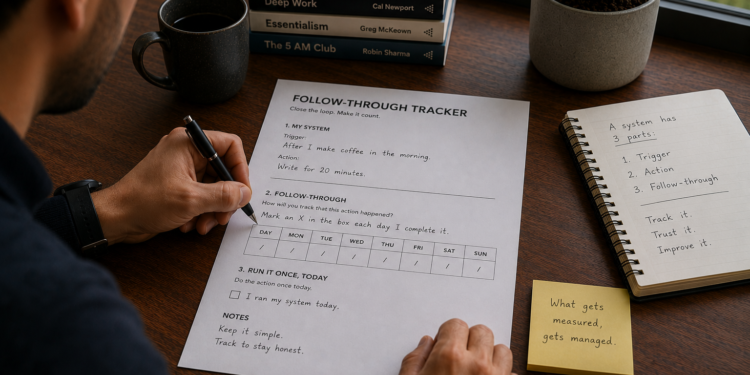
A trigger and an action aren’t a complete system without a way to check whether it happened. The Follow-Through Tracker adds that third part, then has you run the whole thing once, today.
The part that tells you the truth
The follow-through feels like paperwork, which is exactly why it gets skipped. It isn’t. Without it, you can’t tell the difference between a system that’s working and one that’s quietly failing, until the gap is too wide to close in a day.
This is the same discipline behind the dashboards I built managing projects at IBM, not because tracking is satisfying on its own, but because it’s the only honest way to catch a slip early.
Who this is for, and how long it takes
About 7 minutes. For anyone who has a trigger and action defined and needs the last piece.
What’s inside
- A follow-through field.
- A checkbox to run the system once, today.
How to get the most out of it
Choose something simple enough to actually keep using. A tally beats an elaborate tracker you’ll abandon in a week.
What changes if you actually do this
The output is a complete, running system. The outcome is that you can tell the difference between working and failing before it’s too late. The impact is that your intention survives an ordinary bad week.
Download The Follow-Through Tracker
Next step: The Quality Review Checklist, for once your system is producing something to actually ship.
FAQ
How is this different from the full Continuity Design Template?
Same content, split in two. This is the second half, for after you’ve already defined a trigger and action.
What if my trigger fails in the first few days?
Change the trigger before you change anything else. It’s the most common point of failure.
Do I need special tools to track follow-through?
No. A paper tally or a single note works better than an app most people abandon within a week.


![Why Does Your System Only Work When You Feel Like It? (The Two Parts Every System Actually Needs) Every system that holds has the same starting point: a fixed trigger and one small, defined action. The Trigger-Action Designer builds both in about 7 minutes, the two parts most plans skip in favor of just deciding to try harder. A system is a structure, not a feeling At IBM, we didn’t manage large accounts by hoping the team felt inspired on a given Tuesday. We built fixed checkpoints, specific and repeatable. I didn’t think of that as a life skill at the time. It is one. A trigger has to be fixed, never “whenever I feel like it,” and an action has to be small enough to do without deciding. Who this is for, and how long it takes About 7 minutes. For anyone who has an intention but no system carrying it yet. What’s inside A trigger field. An action field. A worked example. How to get the most out of it Resist making the action bigger than it needs to be. Small enough to do without deciding is the whole point. What changes if you actually do this The output is one designed system start. The outcome is that the action becomes something you don’t have to decide on. The impact is that your intention gets a structure to run on. Download The Trigger-Action Designer [Download button placeholder, to be added.] Next step: The Follow-Through Tracker, which adds the part most systems skip and runs the whole thing for the first time. FAQ How is this different from the full Continuity Design Template? The full template includes the follow-through step too, in one sitting. This is the first half, for a quick start. What if I can’t think of a good trigger? Anchor it to something that already happens every day, closing your laptop, making coffee, a specific time. Consistency matters more than cleverness. Does this work for team systems, not just personal ones? Yes. The same trigger-and-action logic applies to a team habit as much as a personal one.](https://yassinebentaleb.com/wp-content/uploads/2026/07/Why-Does-Your-System-Only-Work-When-You-Feel-Like-It-The-Two-Parts-Every-System-Actually-Needs-350x250.png)