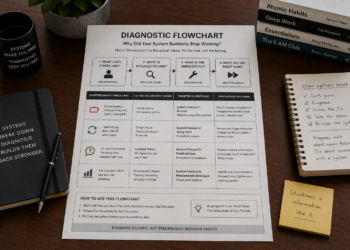
Every tool enjoys a honeymoon. Novelty reads as value, and sunk enthusiasm defends itself against evidence. Kill Criteria is a discipline borrowed from every field that manages enthusiasm professionally: write the exit condition before the honeymoon, not after.
Why the honeymoon is the only honest moment to write the exit
Adoption arrives on enthusiasm, stays by inertia, and bills monthly on a promise nobody ever audited. By the time a tool has proven disappointing, the sunk cost is already defending it, quietly, in the background. The only clean moment to set the exit terms is before that defense mechanism switches on, at the moment of adoption itself.
Through Impactedia, the pattern is consistent: most people are not missing tools. They are buried in them, paying monthly for a stack nobody has re-justified in a year.
Who this is for, and how long it takes
About 20 minutes for your current stack, then a habit applied at every new adoption and every quarterly review.
What’s inside
- A five-row table for writing kill criteria against your current subscriptions and tools.
- A template sentence for anything new you are about to adopt.
- A note on what usually happens once the criteria are actually applied.
How to get the most out of it
The form matters more than the content: a written condition, a date, a verdict. Netted time actually positive. Quality actually judged better. The subscription actually cheaper than what it replaced. Whatever fits the tool, as long as it is checkable rather than vague.
What changes if you actually do this
The output is a short table of conditions instead of an ever-growing, unexamined stack. The outcome is usually a stack that shrinks by half within two quarters, with nothing that mattered missed. The impact is that the survivors finally get used properly instead of merely maintained, because the attention the abandoned tools were consuming comes home.
Download Kill Criteria
Next step: apply this table again at your next quarterly review. Every standing tool re-defends its seat, every time.
FAQ
What if I cannot bring myself to write a real kill date for something I like?
That reluctance is itself information. Tools worth keeping usually survive honest criteria easily. The ones that provoke resistance are often the ones worth examining first.
Does this only apply to software and subscriptions?
No. It works for any standing commitment with a recurring cost, memberships, habits, even recurring meetings, anything that can quietly outlive its usefulness.
What happens if a tool fails its own criteria?
It goes, on schedule, without a renegotiation. The whole point of writing the criteria early is removing the need to relitigate the decision later, tired and attached.