
• Start Here
  • The Method
  • Guides
  • About
  • Let’s Collaborate
  • العربية
  • Français
No Result
View All Result
  • Start Here
  • The Method
  • Guides
  • About
  • Let’s Collaborate
  • العربية
  • Français
No Result
View All Result

🦅 » All Resources » Workbooks » What Do You Do the Moment Your System Starts Slipping? (Deciding Your Fix in Advance)

What Do You Do the Moment Your System Starts Slipping? (Deciding Your Fix in Advance)

What Do You Do the Moment Your System Starts Slipping (Deciding Your Fix in Advance)

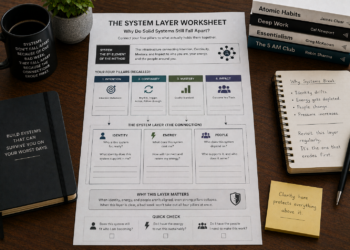
Most systems don’t fail because they were wrong. They fail because nobody decided, in advance, what to do the first time it stopped sticking. The One-Variable Adjustment Plan makes that decision now, before it’s needed.

Change one thing, never the whole system

Most people only ever run the foundation phase, then quietly stop the first bad week and read that as proof the plan didn’t work. It usually just means no one had decided what to adjust.

The fix is smaller than people expect: change the trigger or the action, never the whole system at once.

Who this is for, and how long it takes

About 7 minutes. Works best after The Foundation Phase Planner.

What’s inside

  • A pre-decision field.
  • A signal field.

How to get the most out of it

Write this down even if nothing feels wrong yet. It’s much harder to think clearly about it once something actually slips.

What changes if you actually do this

The output is a pre-decided adjustment. The outcome is a specific, calm response instead of a panicked restart. The impact is fewer systems abandoned at the first real test.

Download The One-Variable Adjustment Plan

Enter your email and the PDF lands in your inbox in a moment.

Next step: The Autonomy Checkpoint, for defining what running without you actually looks like.

FAQ

How is this different from the full 90-Day Implementation Plan?

The full plan covers all three phases in one document. This is just the middle phase, Adjustment.

What if I don’t know what to change yet?

Start with the trigger. It’s the most common point of failure, and the easiest to test.

Can I use this more than once for the same system?

Yes. Systems usually need more than one adjustment before they hold.

Tags: ImplementationSystemThe Shift WheelWorkbooks

Related Posts

How Do You Know If Your Work Is Actually Good Enough to Ship? (Separating Quality From Fear of Finishing)
Workbooks

How Do You Know If Your Work Is Actually Good Enough to Ship? (Separating Quality From Fear of Finishing)

How Do You Know If Your System Is Actually Working? (The Part Most People Never Track)
Workbooks

How Do You Know If Your System Is Actually Working? (The Part Most People Never Track)

Why Did Your System Suddenly Stop Working? (Matching the Symptom to the Actual Failure)
Workbooks

Why Did Your System Suddenly Stop Working? (Matching the Symptom to the Actual Failure)

Your subscription could not be saved. Please try again.
Your subscription has been successful.

The Shift Wheel

A free email series. One short 7-minute exercise a day, building toward your system that actually holds

  • The Method
  • All Guides
    • Intention
    • Continuity
    • Mastery
    • Impact
    • System
  • All Reflections
    • Personal Journey
    • Contemplations
  • All Resources
    • Tools
    • Workbooks

Popular this week

How Bluehost Solves the Problem of an Unreliable First Website

How Flowith Solves the Problem of Thinking That Goes Nowhere

SurveyMonkey to Measure What Your Work Actually Produces for the People It Serves

Yassine Bentaleb

I help people and organizations build systems that turn intention into action, stories into influence, and purpose into impact you can measure and tell.

Guides

  • Intention
  • Continuity
  • Mastery
  • Impact
  • System

Quick Links

  • Start Here
  • About
  • Let’s Collaborate

Useful Links

  • The Method
  • All Guides
  • All Resources
  • All Reflections
No Result
View All Result
  • Start Here
  • The Method
  • Guides
  • About
  • Let’s Collaborate
  • العربية
  • Français