
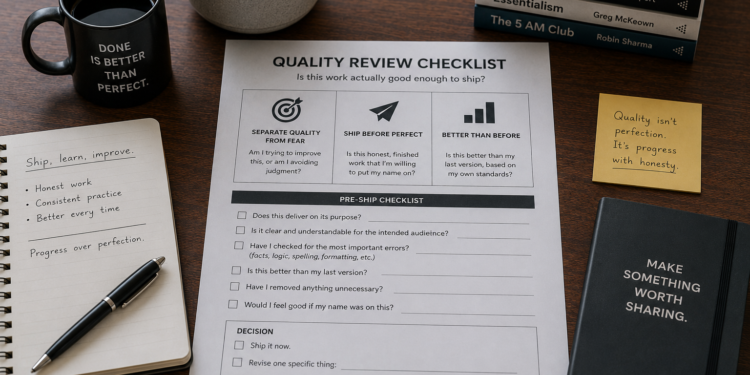
Perfectionism isn’t devotion to good work. It’s fear of mistake wearing the costume of high standards. The Quality Review Checklist replaces that fear with a real question: is this better than your last version, and is it honest work you’re not afraid to ship. Mastery, one of the Method’s five elements, asks that question, not “is this perfect.”
The standard perfectionism actually protects
Most of the work I’ve watched stall under the label “not ready yet” wasn’t actually unfinished. It was unreleased, held back by a standard nobody could name, because the real standard was never quality. It was avoiding the discomfort of being judged.
What the checklist actually checks
- Separate quality from fear: are you improving this, or avoiding judgment?
- Ship before perfect: honest, finished work counts for more than work delayed by overthinking.
- Better than before: compare this to your own last version, not an impossible ideal.
Mastery is the third of the Method’s five elements, the craft dimension that keeps a running system from producing sloppy or fear-driven output. Continuity without Mastery just means showing up reliably to do mediocre work.
Who this is for, and how long it takes
A few minutes, run right before anything leaves your hands. For anyone whose work sits finished but unshared.
What’s inside
- The three checks above.
- A short pre-ship checklist to run on the actual piece of work in front of you.
How to get the most out of it
Run it on the real thing you’re about to ship, not hypothetically. Compare it to your own history, not to someone else’s finished product, that comparison is never fair and never useful.
What changes if you actually do this
The output is one completed review. The outcome is that you can tell the difference between a real quality concern and fear. The impact is that your system keeps producing work you’re willing to put your name on, without stalling indefinitely.
Download the checklist
Next step: Read the Method →, or see the Personal Continuity Design Template, the system that should be producing this work.
FAQ
Isn’t shipping before perfect just lowering my standards?
No. The standard is “better than before, and honest,” which is often harder to meet than a vague sense of “perfect,” and it’s the only standard you can actually act on.
How do I know if I’m avoiding judgment or genuinely improving something?
Ask what specifically you’d change and why. If you can name it, it’s a real revision. If you can’t, it’s usually fear.
Does this apply to any kind of work?
Yes. It’s built for any output you’re about to ship, a piece of writing, a product, a piece of client work.