
When work breaks down, almost everyone reaches for the same explanation. I need more discipline. I have to want it more. The verdict is always about willpower, and it is almost always wrong.
An engineer does not respond to a failing system by telling it to try harder. They read the signals and find the point of failure. Your life deserves the same diagnosis. Most of what you call a personal failing is a system telling you, precisely, where it broke.
Here is how to read four of the most common signals.
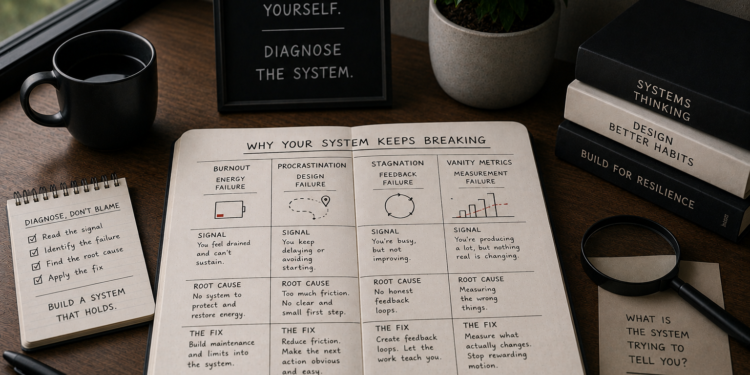
Burnout is an energy failure
Burnout rarely means you did too much. It means you executed without the system protecting your energy. You kept drawing on a reserve that nothing was refilling. The fix is not rest as a reward. It is building maintenance and limits into the structure, so the reserve is protected before it runs out, not after.
Procrastination is a design failure
When you keep not starting, the problem is rarely the goal. It is the distance between you and the first action. Procrastination is the system failing to provide environmental design and a small enough first step. You do not need more pressure. You need less friction and a clearer next move.
Stagnation is a feedback failure
You are putting in the hours, but nothing is improving. This is not laziness. It is the system failing to give you feedback. Without honest signals about what is working, effort runs in place. The fix is to build feedback loops, so the work can teach you instead of just tiring you.
Vanity metrics are a measurement failure
You are producing a lot, and it feels like progress, but nothing real is changing. The system is measuring the wrong thing. Volume is easy to count and easy to mistake for impact. The fix is to measure what actually changes because of the work, even when it is harder to see, and to stop rewarding motion that moves nothing.
The shift the diagnosis makes
Notice what all four have in common. None of them is a character flaw. Each is a specific component of the system doing its job poorly, and each has a specific repair. That is the whole point of diagnosing instead of blaming. A character flaw leaves you ashamed and stuck. A system failure leaves you with something to fix.
So the next time something breaks, resist the easy verdict. Do not ask what is wrong with me. Ask the more useful question: which part of my system is failing, and what does it need?