
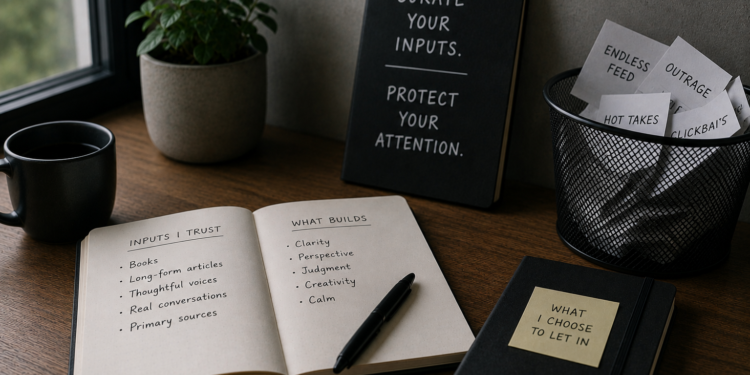
We spend enormous effort improving how we work and almost none deciding what we let in. The articles, feeds, voices, and notifications that enter our attention every day are treated as weather, something that simply happens to us. But a system is only as good as what flows into it, and most people never inspect the supply.
There is an old idea in computing: garbage in, garbage out. No process, however clever, can produce a good result from bad inputs. It is just as true for a person. Feed your mind a stream of noise, outrage, and shallow takes, and no amount of discipline downstream will turn it into clear thinking.
What measurement taught me about inputs
I spent years working in impact measurement, and the lesson that stayed with me had little to do with math. It was that the quality of any analysis is decided long before the analysis begins, at the moment you choose your sources. Bad data does not announce itself. It arrives looking exactly like good data, and it quietly corrupts everything built on top of it.
Most people guard their conclusions and leave their inputs wide open. It should be the reverse. By the time bad input reaches your conclusions, the damage is already done.
Curate the supply, not the output
The instinct is to fix thinking at the end: be more skeptical, correct for bias, filter the noise after it arrives. That is exhausting and rarely works, because you are fighting a flood one bucket at a time.
The leverage is upstream. Decide in advance what is allowed to feed your attention. Which few sources have earned your trust by being honest, careful, and willing to be wrong in public. Which voices make you think rather than just react. Then close the door to most of the rest, not out of fear, but because attention is finite and you are choosing where it goes.
How to audit your inputs
List what actually enters your mind in a normal day. Not what you wish you read, but what you really consume: the feeds, the channels, the people, the half-hour habits.
For each, ask a plain question. Does this leave me clearer or more agitated? More able to do my work, or just more informed about things I will never act on? Keep the few that pass. Be honest about the rest.
You are not obligated to consume everything offered to you. The most underrated decision in any system is what you refuse to let in.