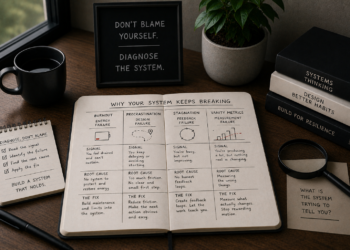
At the end of one year I looked back at a list of everything I had done. It was a long list. Meetings attended, tasks closed, deliverables shipped, hours logged. By every measure of activity, it had been a full year. And yet almost nothing that mattered to me had actually moved.
That gap, between a full list and an empty result, is one of the most common and most expensive confusions in working life. We count hours, meetings, and deliverables, and we mistake the counting for progress. The list was complete. The direction was lost.
What a to-do list is actually for
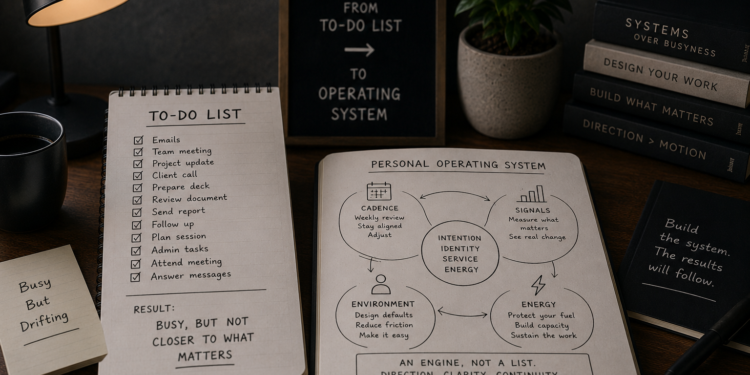
A to-do list is a good tool with a narrow job. It answers one question: what do I do next? That is useful. But it is also the reason so many capable people stay busy for years without building anything that lasts.
A list optimizes for completion. It rewards you for finishing items, regardless of whether those items were worth starting. It has no memory and no direction. Yesterday’s list does not know what this year is for. It cannot tell you that you have closed two hundred tasks while quietly drifting away from the one thing you said mattered.
The shift to an operating system
An operating system answers a different question. Not what do I do next, but what keeps me doing the right next thing without having to decide it each time.
The distinction comes from engineering. A list is a script you re-run by hand, every morning, with your own attention as the engine. A system runs itself. It has a cadence that reviews where you are, signals that tell you the truth about what is changing, and an environment designed so the right action is the easy one. The list still exists, but it lives inside the system now, fed by it, instead of standing in for it.
This is the difference between movement and an engine. Movement needs you to push. An engine keeps turning when your motivation is low, because the structure carries what the mood cannot.
What the system connects that a list cannot
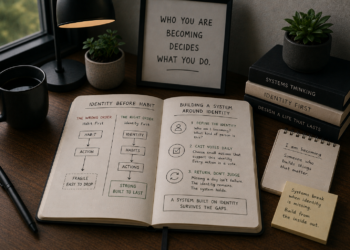
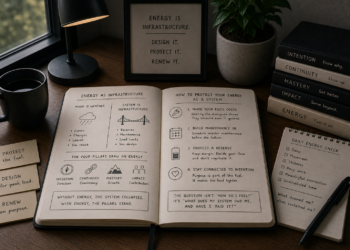
A list sees tasks. A system sees more than tasks. It connects what you do to who you are, to the people and bodies you serve, and to the energy you can actually sustain. That is why a list so often feels arbitrary by Wednesday. It was never attached to anything larger than itself.
When the work is connected, the next action stops being a random item and becomes a move inside something coherent. You are no longer clearing a list. You are running a life that knows where it is going.
How to begin the shift
You do not need to abandon your list. You need to build the layer above it. Add a weekly review that asks not whether you finished, but whether you moved in the right direction. Add one honest signal that shows real change rather than volume. Design one part of your environment so a good action happens by default instead of by decision.
Do that, and the question that runs your week begins to change. You stop asking whether you were busy. You start asking whether the engine was running. The first question can be answered by any full day. The second can only be answered by a system.