A lot of frustration comes from running everything in your life at the same speed. You revise your goals as often as your to-do list. You question your direction on a hard Tuesday. You let a bad week make you doubt who you are. Everything is up for renegotiation all the time, and the result is motion without ground.
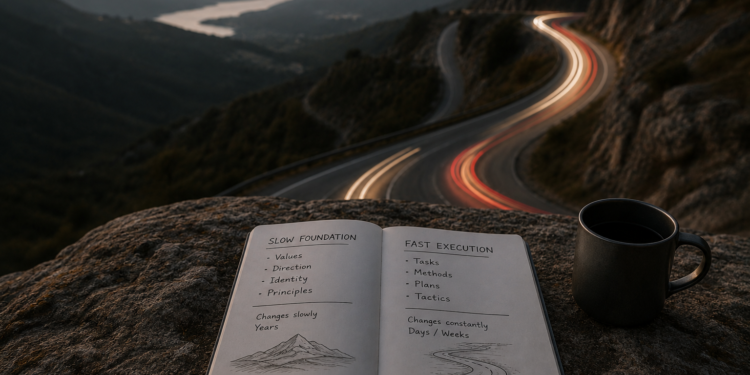
A durable system runs at two speeds, not one. There is a slow layer that should almost never change, and a fast layer that should change constantly. Most people’s problem is that they have mixed the two: they keep redrawing the foundation and rigidly defending the details.
The slow foundation
The slow layer is who you are and where you are going. Your values, your direction, the kind of person you are becoming, the few principles you actually live by. These should move slowly, over years, with great reluctance. They are the ground you stand on, and ground that shifts every week is not ground at all.
In the framework I write from, this slow layer is the deepest part of the system, the part that connects everything you do back to intention and identity. It is meant to be stable on purpose, so that everything above it can move freely.
The fast execution
The fast layer is how you act today. Your tasks, your methods, this week’s plan, the specific tactics you are trying. These should change all the time, in response to feedback, without any sense of crisis. Changing your method is not a betrayal of your direction. It is how you pursue it.
The two speeds protect each other. A stable foundation lets you experiment freely at the surface, because a failed experiment costs you a tactic, not your identity. And fast execution keeps the foundation honest, because principles are tested by how you act, not by how you describe yourself.
How to separate the two
When something goes wrong, ask which layer it belongs to before you react. A bad week is almost always a fast-layer problem, a tactic to adjust, not a reason to question who you are. Treating a surface failure as a foundation crisis is how people talk themselves out of paths they should have kept.
Write down your slow layer once, plainly, and let it sit. Then give yourself full permission to change everything above it as often as the work requires.
The question is not whether to be consistent or flexible. It is to know which parts of your life are which, and to stop running them at the same speed.