The Trap of Outcome-Based Thinking
You have probably heard the advice by now. Forget goals, focus on systems. It is repeated so often that it has started to sound like permission to stop caring where you are going. That is not what it means, and the flattened version does more harm than the cliché it replaced.
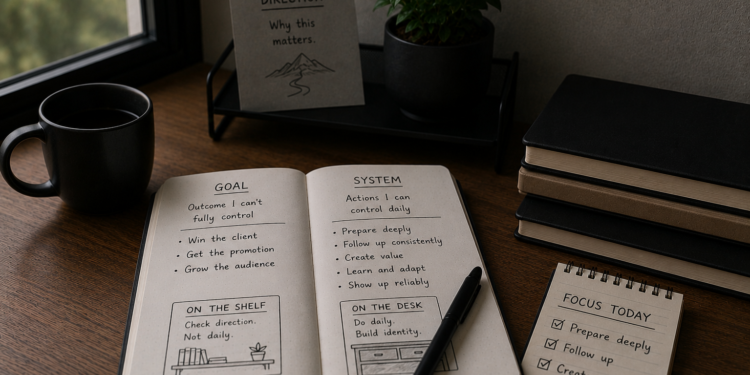
Here is the distinction that actually holds. A goal names an outcome. A system names the behavior that produces it. The trouble is that most goals point at things you do not fully control.
Win the client. Get the promotion. Grow the audience. Each of those depends on other people deciding things you cannot decide for them. You can do everything right and still not get the outcome, and you can get the outcome partly by luck. A target you do not control is a poor place to put your daily attention, because it tells you almost nothing about what to do today.
This is not a new idea. Scott Adams popularized the “systems vs. goals” distinction. James Clear refined it into a core principle of Atomic Habits. But somewhere along the way, the nuance got lost. The conversation turned into a binary choice: either you are a goal person or a system person. That binary is the problem.
Goals set direction. Systems make progress. You need both, arranged so each does its job without interfering with the other. The rest of this piece is about how.
Goals vs. Systems: What the Popular Advice Gets Wrong
The most common misinterpretation I see is people abandoning goals entirely and mistaking any routine for a system. Waking up at 5 AM is not a system. Checking emails in batches is not a system. These are habits. A system is a deliberate structure that turns a direction into daily action and then closes the loop with feedback.
A goal sets direction. Without it, you optimize for the wrong thing, or for nothing at all. A system makes progress. Without it, your direction stays stranded as a wish.
The question is not which one to pick. It is how to arrange them so that each does its job without interfering with the other. That is where the shelf metaphor comes in.
Why Outcomes Belong on the Shelf
For years at IBM, my work was measured in revenue. I hit targets and I missed them, and over time I noticed something uncomfortable. The number went up and down for reasons that had little to do with the quality of my work that quarter. Markets moved. Deals slipped for reasons no effort could have changed. Exchange rates fluctuated. Competitors undercut pricing. None of it was in my control.
What I could actually control was narrower and quieter: how I prepared for each client meeting, how I followed up, how honestly I read a situation, how systematically I stayed in touch with my pipeline. When I built those into a repeatable way of working, the outcomes improved on average, even though no single result was ever guaranteed. The system was the part that belonged to me. The number was the part that did not.
This is the insight the shelf metaphor captures. The goal, the outcome, belongs on the shelf. On the shelf, it is visible. You glance at it to check your direction and to decide what to adjust. But it does not sit on your desk demanding a verdict every single day, because a daily verdict on something you cannot control only produces anxiety and noise.
The shelf is not a place of forgetting. It is a place of proper distance. You keep the outcome close enough to guide you, but far enough that it does not consume your daily attention.
What Belongs on Your Desk Instead
On the desk goes the system: the behaviors you can perform today regardless of outcome. These are the actions that are entirely yours. No one else needs to approve them, no market condition needs to align, no luck is required.
In the framework I write from, this is exactly what the System element does. It connects who you are and what you intend to the actions you can actually repeat, so intention does not stay stranded as a wish. A good system has three qualities. It is repeatable: you can do it today, tomorrow, and the day after without waiting for conditions to be perfect. It is measurable: you can tell, at the end of the day, whether you did it or not, with no ambiguity. And it is adjustable: when the feedback from the shelf tells you something is off, you can change the system without changing who you are.
Here is a concrete example. Suppose your goal is to grow your email list to 10,000 subscribers. That outcome is on the shelf. What is on your desk? The system might be: publish one article per week, add a lead magnet at the end of each article, and share it on two platforms. That is a system. You can do it today. You can do it next Tuesday. The outcome might take six months, but the system keeps you moving every single day.
How to Build Your First System in 3 Steps
You do not need a perfect system. You need a starting one. Here is how to build it in three steps.
Step 1: Split the goal from the system
Take any goal you are carrying and write it down. Then, beneath it, write the smallest set of actions you could perform this week whether or not the outcome arrives. Be honest. If the outcome depends on someone else’s decision, it belongs in the first list. If it depends only on you, it belongs in the second.
Example:
- On the shelf: Get promoted to senior manager.
- On the desk: Have one career conversation per month, deliver one project ahead of deadline, write one monthly summary of my contributions.
Notice that the desk list contains nothing that requires a promotion committee to act. It contains only things you can do regardless of what the committee decides.
Step 2: Define the smallest repeatable unit
A system fails when it asks for too much too soon. Define the smallest version of the action that still counts. If writing for thirty minutes feels hard, write for five. If reaching out to one new contact feels hard, reach out to one person you already know. The size does not matter. What matters is that the system is so easy you cannot say no to it.
Step 3: Schedule the check-in, not the worry
Pick a regular interval, weekly, bi-weekly, or monthly, to look at the shelf. During that check-in, ask three questions:
- Is the direction still right?
- Is the system producing movement?
- What needs to change?
Outside that check-in, your attention stays on the desk. If a thought about the outcome surfaces, note it and let it go. It will be handled at the next check-in. This is not avoidance. It is discipline.
The Feedback Loop: When to Check the Shelf
The frequency of your shelf check-ins depends on the time horizon of your goal.
Short-term goals, weeks to months, get checked weekly. The system can be adjusted quickly. Medium-term goals, months to a year, get checked monthly, giving the system enough time to produce results before you evaluate it. Long-term goals, years out, get checked quarterly. The shelf is for direction, not for daily measurement, and a quarterly review is enough to stay on course.
The key is to align the check-in cadence with the nature of the goal, not with your anxiety about it. Checking daily does not speed up a long-term goal. It only speeds up your burnout.
Common Pitfalls, and How to Avoid Them
Even with a clear distinction between shelf and desk, a few traps are easy to fall into.
System rot
You build a system, it works for a while, and then it stops working. The system has rotted, not because you failed, but because the conditions changed. The fix is not to abandon systems. It is to schedule regular system reviews as part of your shelf check-in, and adjust the system without guilt.
Mistaking activity for progress
A system can keep you busy without moving you toward your direction. This is the most dangerous form of procrastination. The antidote is the shelf check-in. If the system is not producing the kind of movement you expect, change the system. Do not just keep running it faster.
Perfectionism disguised as planning
You want to build the perfect system before you start. You research, you design, you optimize, but you never act. The fix is to start with a deliberately imperfect system. A system that exists is better than one that is perfectly designed on paper. You can improve it later. You cannot improve what you have not started.
Frequently Asked Questions
Should I abandon goals entirely and just focus on systems?
No. Goals set direction. Without a goal, you optimize for the wrong thing, or for nothing at all. Keep the goal on the shelf, visible but not consuming your daily attention, and put the system on your desk, the actions you can take today.
How do I know if my system is working?
During your scheduled check-in, ask three questions: Is the direction still right? Is the system producing movement? What needs to change? If the system is not moving you toward your direction, adjust it. Do not just run it faster.
What if I can’t maintain my system?
Your system is too big. Make it smaller. The smallest version of the action that still counts is the right size. If writing for thirty minutes feels hard, write for five. The only rule is that you do it.
How often should I check my goals?
It depends on the time horizon. Short-term goals, weeks to months, get checked weekly. Medium-term goals, months to a year, get checked monthly. Long-term goals, years out, get checked quarterly. Align the cadence with the nature of your goal, not with your anxiety about it.
What’s the difference between a system and a habit?
A habit is a single automatic behavior. A system is a deliberate structure that turns a direction into daily action and closes the loop with feedback. Habits can be part of a system, but a system is more than the sum of its habits. It includes the check-in, the adjustment, and the alignment with your direction.
The System Is Yours
Outcomes depend on markets, luck, timing, and other people. You can influence them, but you cannot own them. A system belongs entirely to you: the one thing in your work and your life you can design, execute, and improve without anyone else’s permission.
The question is not whether you have ambitious goals. It is whether you have built something you can actually do today that points toward them.
This article is part of the System series within The Method, a framework for turning intention into daily action.