
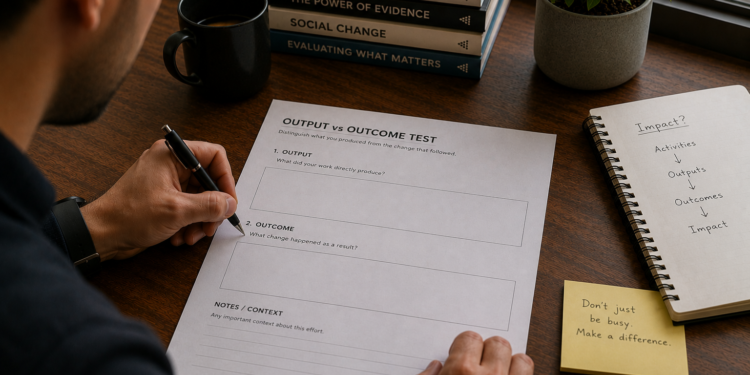
An output is what your work directly produced. An outcome is the change that followed. The Output vs Outcome Test is a quick way to check whether you actually have both, or just one dressed up as the other.
Why busy and effective aren’t the same thing
During my fellowship at the Miller Center, I spent months inside data from more than a thousand social entrepreneurs. The strongest-looking reports weren’t always the ones creating the most change.
Often they’d just learned to report activity as if it were proof. It’s an easy habit to fall into, in a program or in an ordinary week of your own life.
Who this is for, and how long it takes
About 7 minutes, for one specific effort.
What’s inside
- An output field.
- An outcome field.
How to get the most out of it
Leave the outcome field blank if you don’t actually know yet. That’s more honest than guessing.
What changes if you actually do this
The output is one clear answer for each. The outcome is that you stop mistaking activity for proof. The impact is that future claims about your work get more defensible.
Download The Output vs Outcome Test
Next step: The Impact Honesty Check, which looks one layer further, at the transformation this could build toward.
FAQ
How is this different from the full Impact Measurement Canvas?
The full canvas adds a third layer, transformation, and a written honesty check. This is the fast, two-field version.
What if I only have output data right now?
That’s common, and worth naming honestly. It tells you exactly what to check next.
Is this only for nonprofits or impact-focused work?
No. Any work that claims to produce change benefits from this distinction.

![Why Does Your System Only Work When You Feel Like It? (The Two Parts Every System Actually Needs) Every system that holds has the same starting point: a fixed trigger and one small, defined action. The Trigger-Action Designer builds both in about 7 minutes, the two parts most plans skip in favor of just deciding to try harder. A system is a structure, not a feeling At IBM, we didn’t manage large accounts by hoping the team felt inspired on a given Tuesday. We built fixed checkpoints, specific and repeatable. I didn’t think of that as a life skill at the time. It is one. A trigger has to be fixed, never “whenever I feel like it,” and an action has to be small enough to do without deciding. Who this is for, and how long it takes About 7 minutes. For anyone who has an intention but no system carrying it yet. What’s inside A trigger field. An action field. A worked example. How to get the most out of it Resist making the action bigger than it needs to be. Small enough to do without deciding is the whole point. What changes if you actually do this The output is one designed system start. The outcome is that the action becomes something you don’t have to decide on. The impact is that your intention gets a structure to run on. Download The Trigger-Action Designer [Download button placeholder, to be added.] Next step: The Follow-Through Tracker, which adds the part most systems skip and runs the whole thing for the first time. FAQ How is this different from the full Continuity Design Template? The full template includes the follow-through step too, in one sitting. This is the first half, for a quick start. What if I can’t think of a good trigger? Anchor it to something that already happens every day, closing your laptop, making coffee, a specific time. Consistency matters more than cleverness. Does this work for team systems, not just personal ones? Yes. The same trigger-and-action logic applies to a team habit as much as a personal one.](https://yassinebentaleb.com/wp-content/uploads/2026/07/Why-Does-Your-System-Only-Work-When-You-Feel-Like-It-The-Two-Parts-Every-System-Actually-Needs-350x250.png)