Every system starts simple and tends toward clutter. You hit a problem, so you add a rule to prevent it. You hit another, so you add another rule. Each one seemed reasonable at the time. A year later you are living inside a structure so heavy with conditions that following it has become its own full-time job.
This is how a personal system quietly turns into bureaucracy. Not through one bad decision, but through a hundred small, sensible additions that no one ever removed.
Key Takeaways
- Every system starts simple and tends toward clutter, one reasonable rule at a time, until following it becomes its own full-time job.
- A rule earns its place only when it solves a problem you actually keep having, not one you imagine or that happened once.
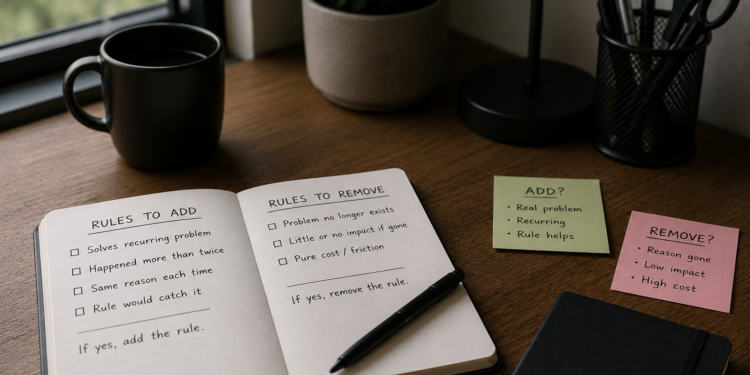
- The test for adding a rule: has this gone wrong more than twice, in the same way, for a reason a rule would catch?
- Most rules outlive their reason; audit them by asking what would actually happen if a given rule were gone.
- Every rule is a small tax on attention paid each time it’s followed, not just when it’s broken, so add slowly and remove freely.
When to add a rule
A rule earns its place only when it solves a problem you actually keep having. Not a problem you imagine, or one that happened once. A real, recurring failure that a rule would reliably prevent.
The test is simple. Has this gone wrong more than twice, in the same way, for a reason a rule would catch? If yes, add the rule. If you are adding it for a problem you have not actually had, you are not building a system. You are decorating it with caution, and that caution will cost you every single day for a danger that may never come.
When to remove a rule
This is the harder direction, and the one almost everyone neglects. Rules are easy to add and feel wrong to remove, because removing one feels like inviting back the problem it was meant to stop.
But most rules outlive their reason. The situation that created them passes, and the rule stays, now just friction with no purpose. So audit them. For each rule in your system, ask what would actually happen if it were gone. If the honest answer is not much, remove it. A rule that prevents a problem you no longer have is pure cost.
The weight no one counts
Here is what makes this matter. Every rule has a hidden price, paid not when it is broken but every time it is followed. A rule is a small tax on attention, levied on each decision it touches, forever.
One rule is nothing. Thirty of them, each individually reasonable, add up to a system that is exhausting to operate, where you spend more energy obeying your own structure than doing the work it was built to protect.
So treat your rules the way a careful engineer treats parts: every one must justify its weight. Add slowly, with evidence. Remove freely, without sentiment. A system stays light not by never adding rules, but by being just as willing to take them away.
This is System maintenance, in the Method‘s sense: keeping the structure light enough to actually carry the work it was built to protect.