
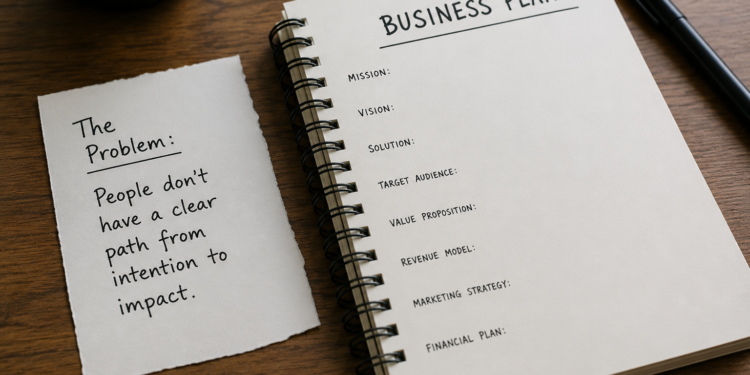
A friend pitched me his startup idea last month: a marketplace connecting local produce farmers to restaurants in Casablanca. Solid market, a clear gap, a working prototype already built. Six months later he wrote to ask why he’d stopped opening his laptop. The idea hadn’t changed. Something else had run out.
This happens often enough that it’s worth naming directly. Most founders test an idea before they test their purpose for it, and expect conviction to show up once the product exists. It rarely arrives in that order.
Key Takeaways
- Most founders test an idea before they test their purpose for it, expecting conviction to show up once the product exists.
- An idea test asks if something can work; a purpose test asks if it’s the specific problem you keep noticing anyway, unpaid and unwatched.
- When the idea comes first, the purpose usually gets retrofitted later, often in language borrowed from other founders’ pitch decks.
- A second question confirms it: would you still care about this problem if the startup around it failed?
- Test the idea after naming the problem, not before; this sits inside Intention, the first of the Method’s five elements.
The idea test and the purpose test
An idea test asks whether something solves a real problem, whether there’s a market, whether it can work. Most business plans pass this test easily, because it’s designed to be passable. A purpose test asks something narrower: is this the specific problem you keep noticing anyway, on the days no one is watching and nothing is measuring you. Very few founders run this second test before they start writing the first business plan.
I didn’t start with an idea when I built CitizenUp. I started with an irritation: how many volunteering opportunities in Morocco never reached the people who actually wanted to give their time, and how many organizations doing real work aligned with the SDGs had no simple way to be found by them. The platform came after that irritation, as a structure built to answer it, not before it as a plan I then went looking for a reason to justify.
Why the order matters
When the idea comes first, the purpose usually gets retrofitted later, often during a pitch deck, dressed in language borrowed from other founders’ decks. It sounds convincing in a room for twenty minutes. It does not hold up on the ordinary evening, eight months in, when the product still needs work and there’s no investor left to perform for. That’s the moment my friend hit with the produce marketplace. The idea was still sound. The reason for doing it, specifically, had never been there.
This is not the same as “follow your passion.” Passion is a feeling, and feelings are an unreliable fuel for a multi-year commitment. A problem you keep noticing is a fact you can point to on a bad day, long after passion has already run out for the afternoon.
What the purpose test actually asks
Not “what problem could I solve,” which invites an answer built to sound good. The sharper question is what you already complain about, uninvited, in ordinary conversation, the thing you bring up without being asked because it genuinely bothers you that no one has fixed it yet.
A second, quieter question helps confirm it: would you still care about this problem if the startup around it failed. If the honest answer is no, the idea was the point, not the problem, and that’s worth knowing before you spend a year on it rather than after.
Where this fits
Test the idea after you’ve named the problem, not before. If nothing comes to mind yet when you ask what you complain about, that’s more informative than a rushed answer. It means the irritation hasn’t surfaced yet, and the idea, however strong the market looks, will have nothing solid underneath it once the excitement of building fades. This sits inside Intention, the first of the Method‘s five elements, where every meaningful pursuit is supposed to begin before it becomes a plan.
FAQ
What if I already have a business idea and I’m not sure it passes the purpose test?
Ask whether you’d still care about the underlying problem if this specific venture failed. If yes, the idea can likely be adjusted around a real purpose. If the honest answer is no, the venture may need a different problem underneath it, not just a better version of the same idea.
Is it too late to find purpose after already building the idea first?
No, but it’s harder to retrofit than to start there. Go back to what actually irritates you about the space the idea sits in, not what sounds good about the idea itself. Sometimes the real purpose was adjacent to the original idea the whole time, just not the headline of the pitch.
Can the purpose test change after you’ve already started?
Yes, and it usually does as the work reveals what you actually care about versus what you assumed you’d care about. What matters is checking in on it honestly every so often, not locking in an answer on day one and refusing to revisit it once the real problem becomes clearer.