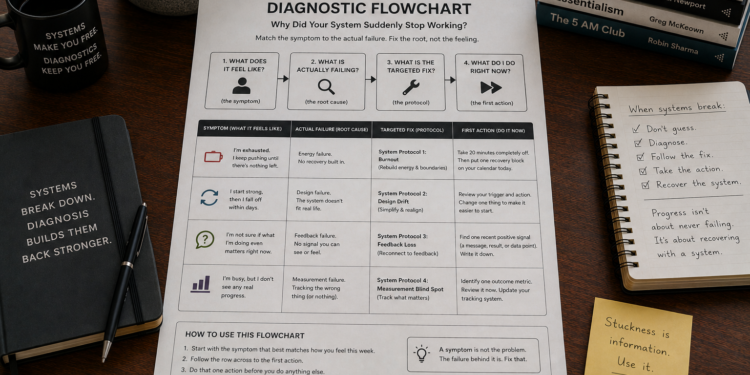
If you’ve felt stuck this week, you’re not short on discipline. Something specific broke, and it’s diagnosable. The Diagnostic Flowchart walks you through four questions, what it feels like, what’s actually failing, the targeted fix, and the first action, so recovery starts with a diagnosis instead of a guess.
“I’m stuck” is a symptom, not a diagnosis
The Gap Self-Assessment names your starting trap before you’ve built anything. This flowchart is for a different moment: when a system you’re already running breaks partway through, and the feeling of being stuck needs a more specific diagnosis than “try harder.”
How the flowchart works
Four questions, in order.
- What does it feel like? (the symptom)
- What is actually failing? (the root cause)
- What is the targeted fix? (the protocol)
- What do I do right now? (the first action)
One example: “I’m exhausted, I keep pushing until there’s nothing left” traces to an energy failure, matched to System Protocol 1: Burnout. This flowchart lives inside System, the fifth element of the Method. Its job isn’t to hold the system together when things are going well. It’s to recover the system when a specific part breaks.
Who this is for, and how long it takes
A few minutes, whenever a system you’re running stalls. For anyone who has felt stuck for more than a few days and wants a diagnosis before another attempt at willpower.
What’s inside
- The four-question flow.
- A symptom-to-protocol matching table.
How to get the most out of it
Answer for the actual week you just had, not a general mood. Follow the matched protocol before trying anything else, resist the urge to skip straight to a fix that isn’t the one diagnosed.
What changes if you actually do this
The output is one identified failure point and matched protocol. The outcome is that you can act immediately instead of spiraling into “what’s wrong with me.” The impact is that the system becomes resilient past its first setback, instead of getting abandoned at the first sign of trouble.
Download the flowchart
Next step: Read the Method →, or see the Gap Self-Assessment, the starting diagnosis this flowchart builds on.
FAQ
How is this different from the Gap Self-Assessment?
The Gap Self-Assessment names your starting trap before you’ve built anything. This flowchart is for recovering a system you’re already running when part of it breaks.
What if my symptom doesn’t match any of the listed ones?
Work backward from the closest match. Most breakdowns cluster around energy, design, feedback, or measurement, the same four areas the Method tracks.
Do I need to use this every time I have a bad day?
No. It’s for when a pattern of stuckness holds for more than a few days, not one off day.