Most people measure their lives the way a struggling company measures itself: by the numbers that are easy to collect and pleasant to read. Hours worked. Tasks closed. Posts published. These numbers go up, and we feel like we are winning, even as the things we actually care about stay exactly where they were.
A dashboard is supposed to tell you the truth. An honest one is harder to build than a flattering one, because honesty often shows you something you would rather not see.
What I learned measuring impact
For years my work was impact measurement: helping organizations tell the difference between activity and change. The hardest part was never the data. It was the willingness to measure the thing that mattered instead of the thing that looked good. A program can run a hundred workshops and change nothing. The honest dashboard is the one that asks what actually changed, not how busy we were.
What is true for organizations is true for a life. You can be relentlessly busy and quietly stagnant, and a dishonest dashboard will hide the gap from you for years.
Two things an honest dashboard tracks
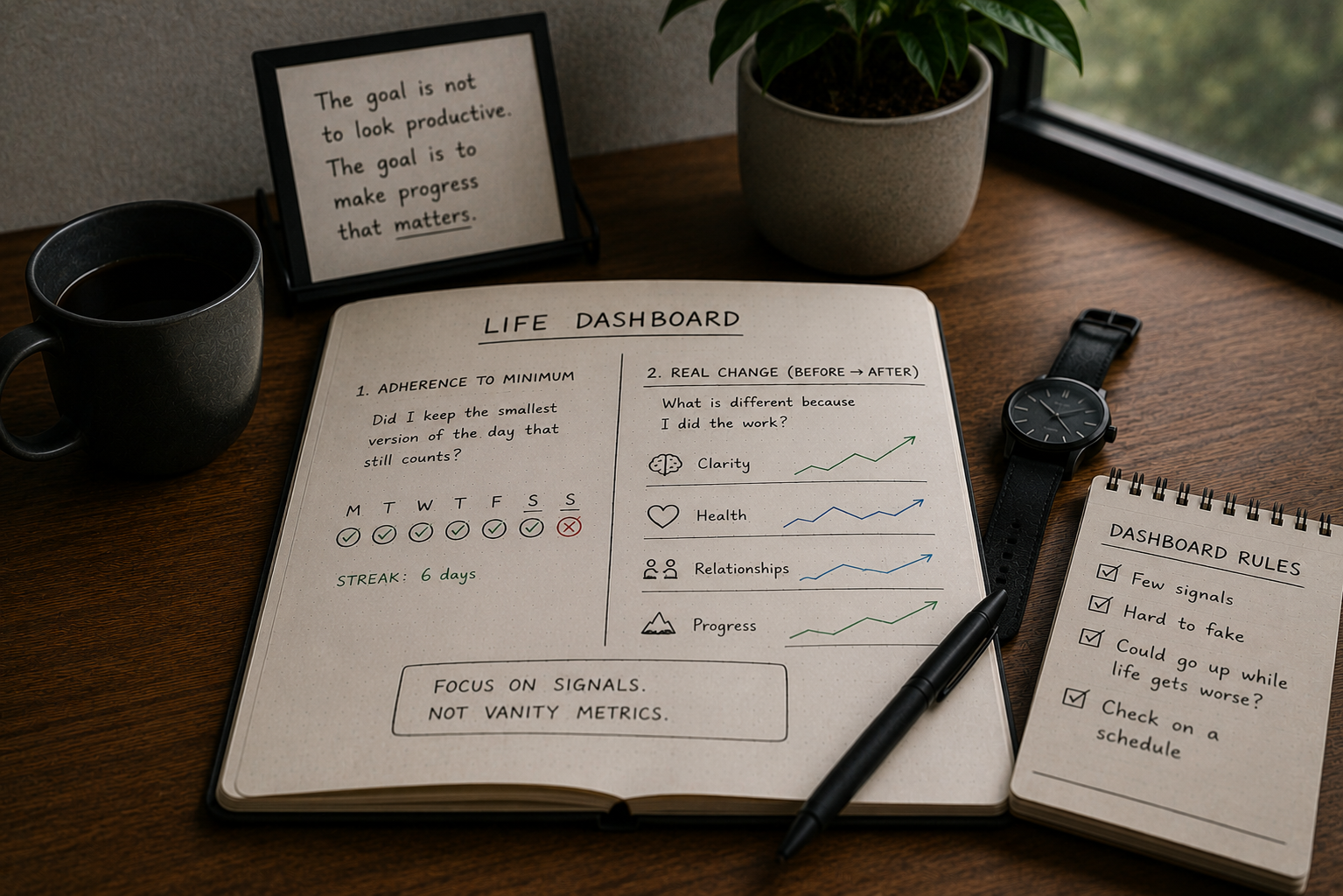
The first is adherence to your minimum, not your maximum. Did you keep the smallest version of the day that still counts? This measures whether your system held, which matters far more over time than any single impressive day.
The second is the before and after of real change. Not how much you did, but what is different because you did it. Are you clearer than last month, healthier, closer to the thing you said mattered? These are slower and harder to read than a task count, which is exactly why they are worth tracking. The easy numbers lie by omission. The honest ones make you face the gap between motion and progress.
How to build yours
Pick a very small number of signals. A dashboard with thirty metrics measures nothing, because you cannot feel thirty things at once. Choose two or three that you would trust to tell you the truth.
For each, ask one test question. Could this number go up while my life gets worse? If the answer is yes, it is a vanity metric, and it belongs off the dashboard.
Then look at it on a schedule, not on a whim. A signal you only check when you already feel good is not a dashboard. It is a mirror you visit for reassurance.
An honest dashboard will not always make you feel better. It will do something more valuable. It will make sure that when you believe you are moving, you actually are.