Everyone has a good system on a good day. The real question is what happens on your worst one. The day you are tired, discouraged, behind, and uninspired. If your way of working only functions when you feel like working, you do not have a system. You have a mood with a to-do list attached.
A personal operating system is what keeps you moving on the day motivation does not show up. It is built for the worst day on purpose, because the worst day is the one that decides whether anything lasts.
The lesson engineering taught me
I started as an engineer, and one principle outlived every job I have held since. An idea is not enough on its own. An idea needs a structure that can carry it. A brilliant intention with no structure beneath it is just a wish waiting to be forgotten.
We accept this for machines and ignore it for ourselves. We assume our intentions will carry themselves on willpower alone. Then willpower runs out, as it always does, and we blame ourselves instead of the missing structure.
What an operating system replaces
An operating system replaces willpower with design. Where willpower asks you to decide and push every single day, a system makes the right action the default, so fewer decisions stand between you and the work.
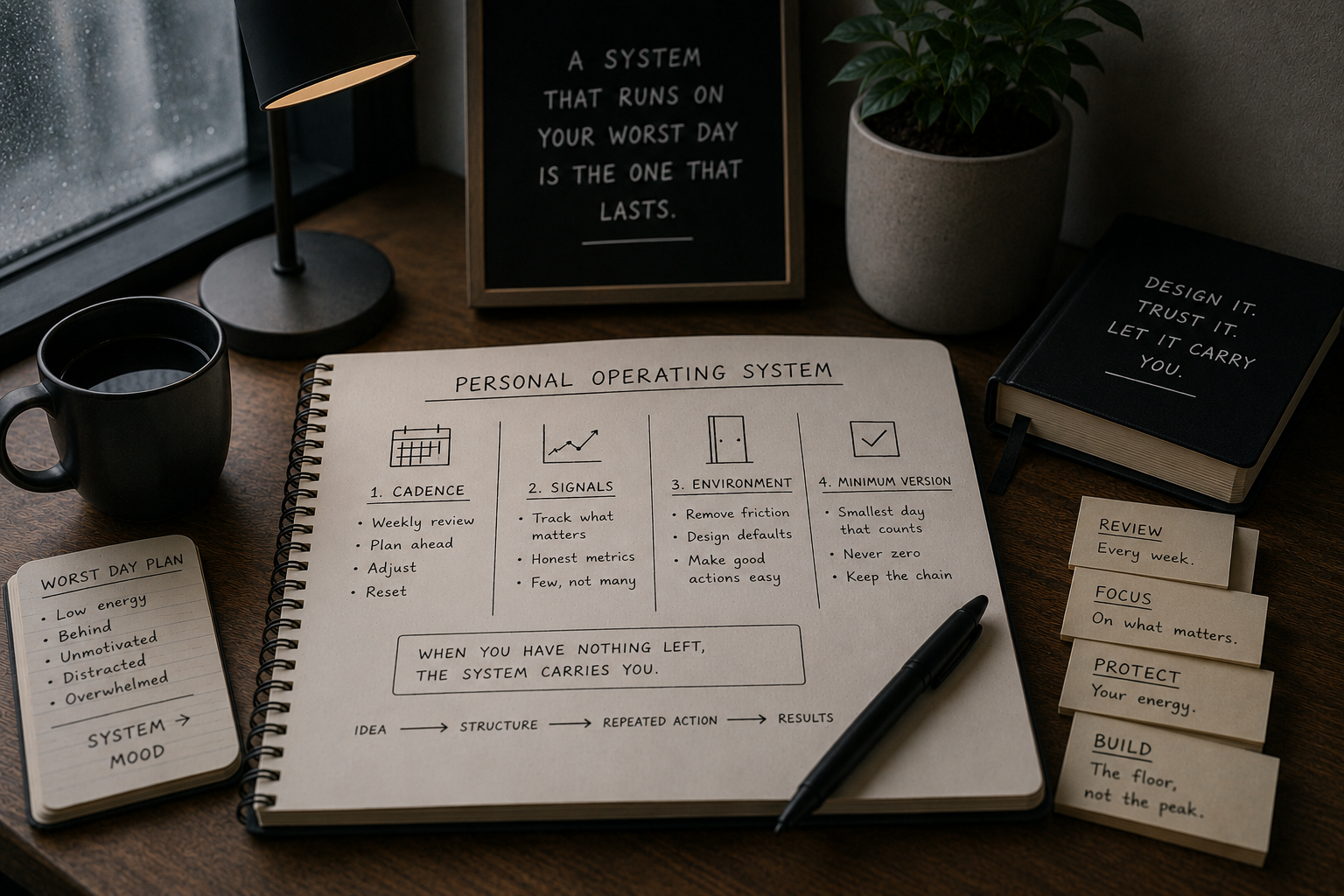
It rests on a few plain parts. A cadence that reviews where you are, so you do not drift unseen. Honest signals that tell you the truth instead of flattering you. An environment shaped so the good action is the easy one. And a minimum version of a day that still counts, so a bad day bends the system instead of breaking it.
How to begin building yours
Start from the worst day, not the best. Ask what the smallest honest version of your work looks like when you have almost nothing left, and build the floor there. A system designed for your strongest self will fail exactly when you need it.
Then externalize what you have been carrying in your head. Put the cadence in a calendar, the signal in a place you will see, the first action in your environment. Anything held only by memory and motivation is already at risk.
Build it once, calmly, while you are able. Then let it carry you on the days you are not. That is the entire promise of a system: not that you will always feel strong, but that your work will continue even when you do not.
The measure of your system is simple. Not how well it runs on your best day, but whether it still runs on your worst.