When Capacity Drops
There are seasons when your capacity simply drops. Not because you stopped caring, but because life arrived: a hard month at work, a sick child, grief, a body that needs rest, a mind that has gone quiet. The plans you made at full strength now feel like they belong to someone else.
It happens to everyone. What matters is not whether it happens. What matters is whether you have something to reach for when it does.
Most advice meets these seasons with the wrong instruction. It tells you to push through, to find discipline, to want it more. But you do not have a motivation problem in a low season. You have a capacity problem. And you cannot push your way out of a capacity problem. You can only design your way through it.
That design has a name. I call it the Minimum Viable Day.
What the Wrong Advice Sounds Like
The most common advice for low seasons is also the most harmful: just do it. Wake up earlier. Try harder. Keep the streak alive at all costs. The self-improvement industry has conditioned us to believe that any gap between intention and action is a moral failure, a lack of grit, discipline, or desire.
But a low season is not a character flaw. It is a biological and psychological reality. When your body is recovering, when your mind is processing grief, when your energy is diverted to simply getting through the day, the advice to “push through” does not help. It adds shame to exhaustion.
The alternative is not to give up. It is to redefine what counts. That is the insight the Minimum Viable Day is built on.
The Minimum Viable Day: An Engineered Solution
In the world I came from, there is a concept called the minimum viable product: the smallest version of something that still works, still ships, still counts as real. Not the impressive version. The version that proves the thing is alive.
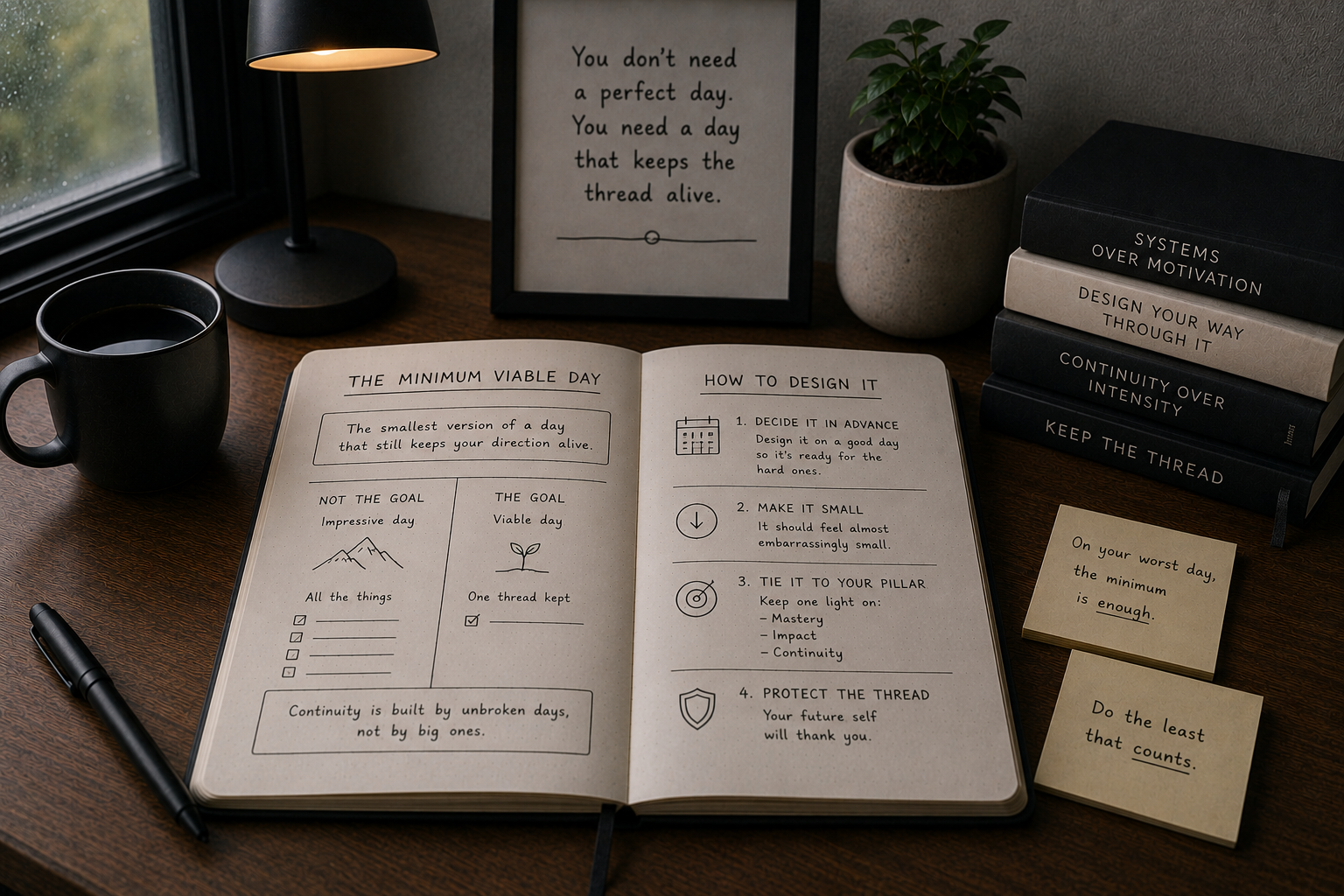
A day can work the same way. The Minimum Viable Day is the smallest version of a day that still keeps your direction alive. It is not the day you are proud of. It is the day that, on your worst week, still counts as having shown up.
Think of it as a floor, not a ceiling. You will have better days, days when you write for an hour instead of ten minutes, when you read twenty pages instead of one. But the floor is what protects you from falling through entirely. The floor is the version of the day you can always reach, no matter how low your energy.
In the framework I write from, this is exactly what the System element does in practice. It connects who you are and what you intend to the actions you can actually repeat, and a Minimum Viable Day is the simplest, most forgiving version of that connection.
Why Continuity Beats Intensity
Continuity is not built by big days. It is built by unbroken ones. The danger of a low season is not that you do less. It is that you stop entirely, and stopping is far more expensive than slowing down.
When you stop, you lose the thread. And picking up a dropped thread costs far more than holding a thin one. The identity quietly shifts from someone who does this to someone who used to. The mind rewires around absence. Returning becomes harder with every day that passes.
This is where intensity betrays you. A high-intensity approach, go big or go home, works when you have energy to burn. But in a low season, it becomes an all-or-nothing trap. If you cannot do the full version, you do nothing. The Minimum Viable Day exists to break that trap. It keeps you, in your own eyes, a person who is still in motion, even when the motion is small.
How to Design Your Minimum Viable Day
Designing your Minimum Viable Day requires three deliberate choices. Make them now, while you are still strong. The worst time to design a low-capacity day is in the middle of one.
Step 1: Define it on a good day
Your minimum should not be improvised. Decide it in advance and write it down. On a good day, your standards are high and your ambitions are clear, and that is exactly when you should define the floor. You are not lowering your standards. You are building a safety net for the version of you that will need it most.
When I designed mine, I asked myself one question: what is the smallest thing I can do that would still let me feel, at the end of the day, that I did not completely let go? The answer was honest, not heroic, not aspirational, just true.
Step 2: Make it almost embarrassingly small
If your full practice is an hour of writing, the minimum might be ten minutes. If it is ten pages of reading, the minimum might be one. If your full workout is sixty minutes at the gym, the minimum might be a five-minute stretch at home.
The test is simple: could you do this on the hardest day you can realistically imagine? If you hesitate, if you need to convince yourself that yes, you probably could, it is still too big. A Minimum Viable Day that requires willpower will fail the moment willpower is gone. It must be so small that it requires no decision. Just execution.
Step 3: Protect one pillar
You cannot protect everything when your capacity drops. Choose one pillar, the one that matters most to your sense of direction and identity, and protect that. Let the others rest.
Perhaps the minimum is one honest line of writing for mastery. One message of connection for impact. One small kept promise for continuity. One deep breath for presence. You are not trying to advance on every front in a low season. You are keeping one light on until the season passes.
That is the hidden logic worth naming: a Minimum Viable Day has a natural tendency to grow. The hardest part is starting, and because the minimum is genuinely small, starting is nearly effortless. Some days it stays at the minimum. Some days it becomes more. Both are wins.
The Hardest Part: Doing It on the Day
Even with a well-designed Minimum Viable Day, the hardest step is actually doing it when the day arrives. A few things help.
Remove the decision. Do not ask yourself whether you feel like doing it, because the answer will always be no. Make the minimum so automatic that you do it before your brain has time to negotiate. The same time, the same place, the same cue, every time, removes the need for motivation.
If even your minimum feels heavy, set the bar lower still. The floor can always move down. The only rule is that it exists at all.
And when you do it, acknowledge it instead of dismissing it as not enough. The voice that says “that was nothing” is the same voice that keeps you from starting. Replace it with: I did what I designed myself to do.
Frequently Asked Questions
What if even my minimum feels too hard?
Lower it. The floor can always move down. If one sentence is too much, write one word. If one stretch is too much, take one deep breath. The only rule is that the minimum exists at all. A tiny step keeps the thread alive; no step drops it.
What if I miss a day?
You will. The Minimum Viable Day is not about perfection, it is about return. When you miss a day, do not double down the next day. Just resume your minimum. The goal is not streak length, it is that the thread is never broken for so long that you forget it exists.
How is a Minimum Viable Day different from just being lazy?
Laziness is avoiding effort you could make. A Minimum Viable Day is a deliberate strategy for a season where you genuinely cannot give more. The difference is intention: you are not shrinking from your potential, you are protecting your continuity so that when your capacity returns, you can step back into motion without starting from zero.
Can I have different minimums for different areas of my life?
Yes, but start with one. Trying to protect everything in a low season is a recipe for protecting nothing. Choose the pillar that matters most to your sense of direction and identity, the one that, if it went dark, would be hardest to relight. Protect that. Let the others rest.
How do I know when the low season is over?
You will feel it. The minimum will start to feel easy, not in a forced way, but naturally. You will find yourself doing more than the minimum without deciding to. When that happens, you can raise the floor. But keep the minimum defined. The next low season will come, and you want it waiting for you.
The Quiet Logic Underneath
There is something almost spiritual in choosing to keep going small rather than waiting to come back strong. It is an act of faith in your own continuity, a way of telling yourself that the season will pass, and that when it does, you would rather return to a thread you held than a thread you have to find again.
The Minimum Viable Day is not a strategy for mediocrity. It is a strategy for survival, and survival, when the season is hard, is success. You are not lowering your standards. You are expanding your definition of what counts as a win, so that even on your worst day, you win.
So the next time your capacity drops, do not ask how to do everything. Ask the smaller, kinder, more durable question: what is the least I can do today that still counts, and have I done it?
This article is part of the System series within The Method, a framework for turning intention into daily action.