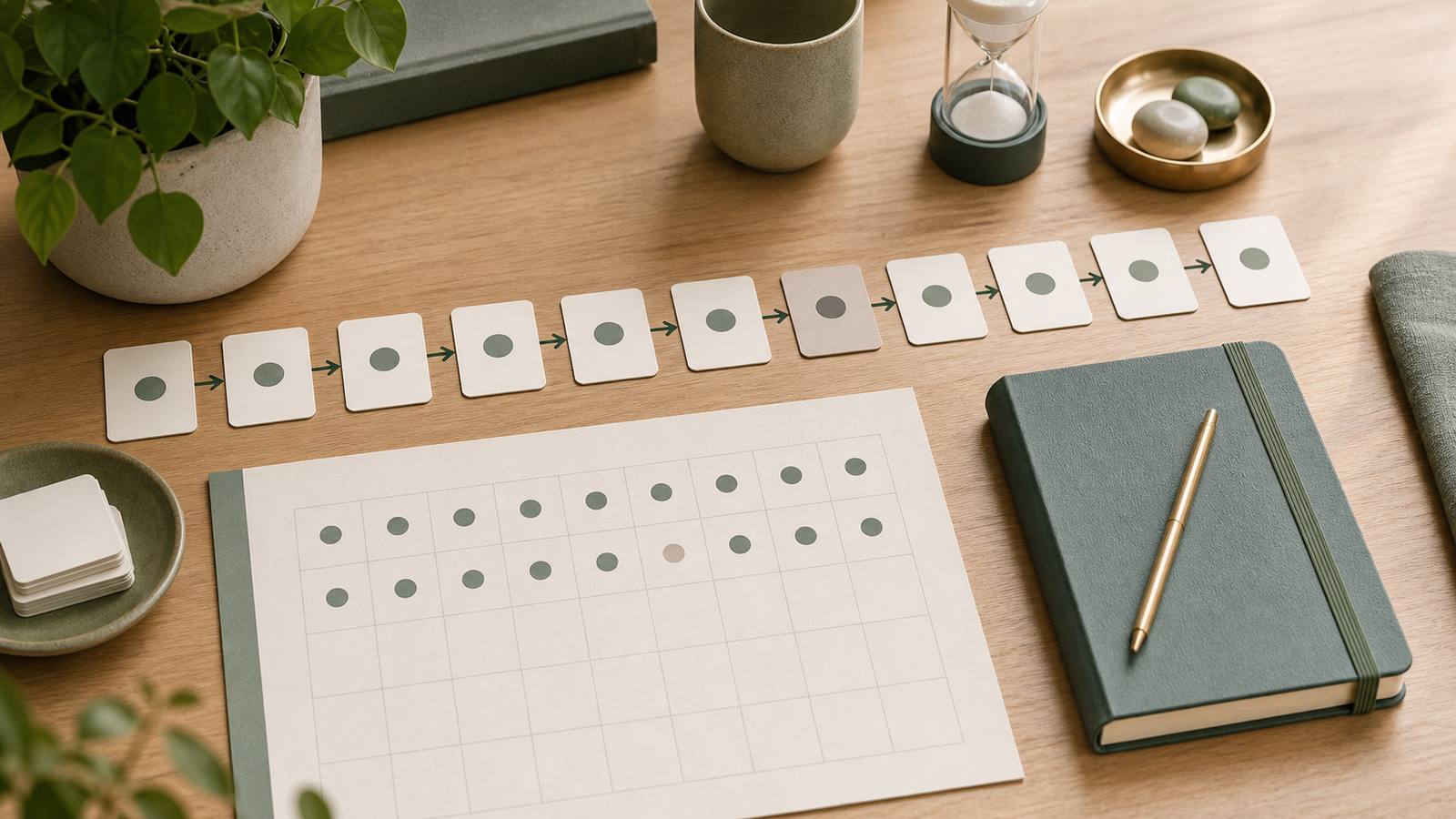

In Laayoune, running an entrepreneurship program with a full calendar of workshops, bootcamps, and competitions, the plan was to block two hours every afternoon for building the actual curriculum. That block almost never survived the week. A stakeholder call ran long, a session needed prep, a bootcamp logistics problem showed up. The two o’clock block on the calendar was competing with everything else that also wanted two o’clock.
What actually worked wasn’t a better calendar block. It was tying the work to a specific action instead of a specific time: the curriculum writing happened right after locking the classroom door at the end of the day’s last session, wherever that fell on the clock. Some days that was 1pm, some days 6pm. The trigger wasn’t a number on a calendar, it was a physical transition that had already happened.
A time-based trigger for deep work competes with every other urgent thing scheduled for that slot. A trigger tied to a physical action or environment change doesn’t compete with anything, because it isn’t a slot at all. This is the basic mechanic behind most reliable habit triggers: a cue, followed by the routine, followed by whatever makes it worth repeating. The part that gets missed in advice about deep work specifically is which kind of cue survives contact with a real, unpredictable schedule. Time survives on a clean calendar. It rarely survives a full one.
Key Takeaways
- A time-based trigger for deep work competes with everything else scheduled for that slot; an action-based trigger doesn’t, because it isn’t a slot at all.
- Pick a trigger action that already happens reliably once a day regardless of how the schedule shifts, not a specific time on the clock.
- Deep work should start immediately after the trigger action, not loosely “around” it.
- An action-based trigger gets more reliable exactly on the days a calendar block would fail.
- If a day genuinely has no version of the trigger action, that’s information about the day, not a sign the habit failed.
What to use as the trigger instead
Pick an action that already happens, reliably, once a day, regardless of how the schedule shifts: closing your laptop after the last meeting, making the same cup of coffee, sitting down at one specific desk instead of wherever’s free. The action has to be something you were already going to do. Deep work starts immediately after it, not “around” it.
The first few days, this will feel weaker than a calendar block, because a calendar block feels like a commitment and a physical cue feels like a habit still forming. It gets more reliable exactly where the calendar block gets less reliable: on the days the schedule falls apart.
If the day genuinely has no version of the trigger action, that’s useful information too, it means there was no real opening for deep work that day, not that the habit failed.
FAQ
Isn’t a fixed time block still useful for deep work?
On a predictable schedule, yes. The distinction matters most when the schedule isn’t predictable, program work, client work, anything with a calendar that gets rewritten by other people. In that context, a cue tied to an action holds up better than a cue tied to a time.
Does this need to be the same action every day?
The same category of action, not necessarily the identical one. What matters is that it’s something the day was already going to produce on its own, so the trigger doesn’t need its own slot to survive.
What if the trigger action itself gets skipped on a chaotic day?
Then deep work likely doesn’t happen that day, and that’s a more honest outcome than forcing it in around a broken schedule. The trigger isn’t meant to guarantee deep work every day, it’s meant to make it reliable on the days the action does happen.