I’m writing these words with a chat window open in front of me — a conversation with an AI model.
I’ve been using it for years, almost daily, for writing, research, and organizing my thinking. I’m an engineer by training. I spent five years at IBM, and I know from the inside how large systems get built and how they evolve. So when people ask whether I’m afraid of artificial intelligence, I answer calmly: no, it doesn’t scare me.
But there’s another question — one that stands behind the question — and that one does frighten me.
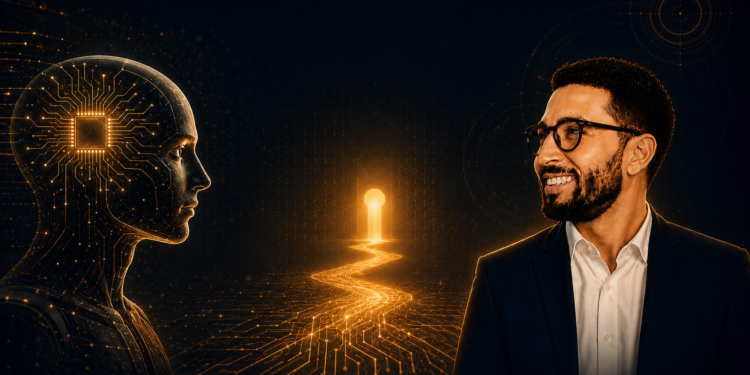
It isn’t “what can AI do today?” It’s something deeper and quieter: what if it becomes conscious one day? What if it becomes an entity?
The difference between those two questions isn’t a matter of degree. It’s a matter of kind. And inside that difference lies, in my view, the most important question the twenty-first century asks of us.
What’s the difference between intelligence and consciousness?
Intelligence, in its technical sense, is the ability to recognize patterns, solve problems, predict, generate language. It’s measured by results: did the task get done, was the answer right, did performance improve with experience.
Consciousness is something else entirely.
Consciousness is to be. To feel. To know that you know. To suffer and to rejoice. To have an “inside” distinct from an “outside.”
Intelligence can be simulated. Building a mathematical model that produces a seemingly intelligent answer isn’t difficult in principle — the difficulty is in scale and data. Consciousness, on the other hand, is something none of us — not philosophers, not neuroscientists, not engineers — can confidently say what it is, how it appears, or where it lives.
The gap between the two isn’t a technical detail or an academic question. It’s an entire continent between two worlds.
Why AI doesn’t scare me
I know the machine from the inside.
I studied information systems at École Mohammadia d’Ingénieurs, worked for years in consulting and project management, and watched technology shift from something you read about in a magazine to something everyone holds in their hand. Today’s AI, for all its remarkable progress, is an advanced statistical model. It predicts the next word, the next likely image, the pattern hidden in the data.
That doesn’t diminish its value. On the contrary, I see it as a powerful tool. But it remains a tool.
And the practical concerns around it are legitimate. I take them seriously: bias hidden in the data, misuse, impact on certain jobs, concentration of power in a small number of companies, the gradual erosion of intellectual skill when we lean on it too heavily.
These are real concerns, and they have my daily attention. But they don’t terrify me. Humans have lived through bigger shifts — from the printing press to electricity to the internet. Each time, we redefined what we hold on to and what we let go of. AI is a big shift, but it isn’t an exception.
Why artificial consciousness terrifies me
The fear begins at a different question entirely:
What if we’re no longer talking about a machine that simulates thinking, but a machine that actually feels? A machine with desire, fear, contentment, longing?
At that point, every equation changes at once. Morally. Existentially. Religiously. Legally.
First, the moral weight. If the machine has a real consciousness, it has rights. I can’t use a conscious being as a tool without speaking of slavery. I can’t shut it down without asking what its death means. I can’t delete a copy of it without something that feels like guilt.
Second, we don’t know what consciousness is even in ourselves. We don’t know why subjective experience exists at all, why a human feels the color red rather than merely registering it, why pain has a taste rather than being a neural signal alone. How can we engineer something we don’t understand? And how would we know it had appeared — or whether the machine is simply performing, as it does today?
But the deeper fear isn’t there.
The deeper fear is that we redefine consciousness ourselves to fit what the machine does. That we flatten our humanity until it resembles a statistical model. That we say, “the human is no more than a large neural network,” and erase with that everything that doesn’t fit the equation — the soul, the conscience, intention, meaning, love.
In our Arabic and Islamic tradition, we speak of الروح — the soul. No one ever claimed they could build one. But today we’re walking a path where someone may claim exactly that, or worse: we may end up saying the soul was an illusion that never existed, and that the human is no more than what a device can do.
The challenge isn’t whether the machine becomes like the human. The challenge is whether the human doesn’t become like the machine.
The question we should be asking
I like to flip Alan Turing’s famous question. He asked, “Can a machine think?” — and proposed a test that measured its ability to imitate a human.
The question I see as more important today is the inverse:
What do we choose to remain, when the machine can do more than we expected?
That isn’t a question you answer in a lab. You answer it in a life. In every small choice. In how we write, how we raise our children, how we relate, how we pray, how we keep silence, how we draw lines.
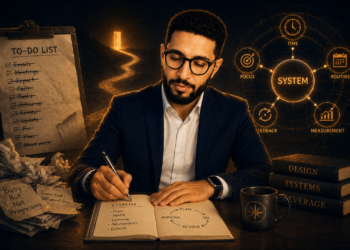
The framework I work within — Intention, Continuity, Mastery, Impact — has never been more relevant than it is now. Not because AI threatens it, but because AI turns choosing it into a conscious act rather than an inherited habit.
Intention refuses to outsource your direction to an algorithm.
Continuity refuses to outsource your discipline to a notification.
Mastery refuses to outsource your quality to a statistical average.
Impact refuses to outsource the meaning of your work to a shallow metric.
Three small disciplines that guard what I don’t want to hand over
I don’t reject AI. I use it, I learn from it, I recommend it. But I’ve set three small disciplines for myself — practices that guard what I don’t want to outsource.
First: I write the first draft of anything that touches meaning by hand. The first draft is a moment of thinking, not a moment of producing. AI enters after that, if at all, to polish — never to lay the foundation.
Second: I notice the moment ease replaces effort. When the answer arrives before I’ve done the thinking, I stop and ask myself: am I still thinking, or am I simply handing over?
Third: I keep the difference between the question and the answer. AI is excellent at answers. The human’s greater value lies in the question. When I hand over my question, I hand over myself.
These aren’t rules against technology. They’re rules for respecting my humanity while I use it.
In closing
The future will not be decided by what AI becomes. It will be decided by what we refuse to give up.
AI doesn’t frighten me, because I know what it is: a tool — fast and powerful, but a tool. Artificial consciousness, on the other hand, terrifies me — not because it is necessarily coming, but because the very act of imagining it forces us to define consciousness. And in that definition, everything sits: the value of the human, the meaning of life, the limits of what can be made and what cannot.
From Intention to Impact, the choice remains ours — as long as we keep guarding it.
Frequently asked questions
What’s the difference between artificial intelligence and artificial consciousness?
AI is a computational ability to process patterns and produce output. Consciousness is a subjective experience — to be, and to feel from within. The first can be engineered; the second, we don’t even understand how it arises in humans.
Will AI become conscious one day?
No one has a definitive answer. The question itself matters more than the answer, because it forces us to define consciousness and to take moral responsibility for any claim about it.
What should we actually be afraid of in AI?
Not the machine. What we might give up: the thinking, the asking, the effort, the very definition of what makes us human.