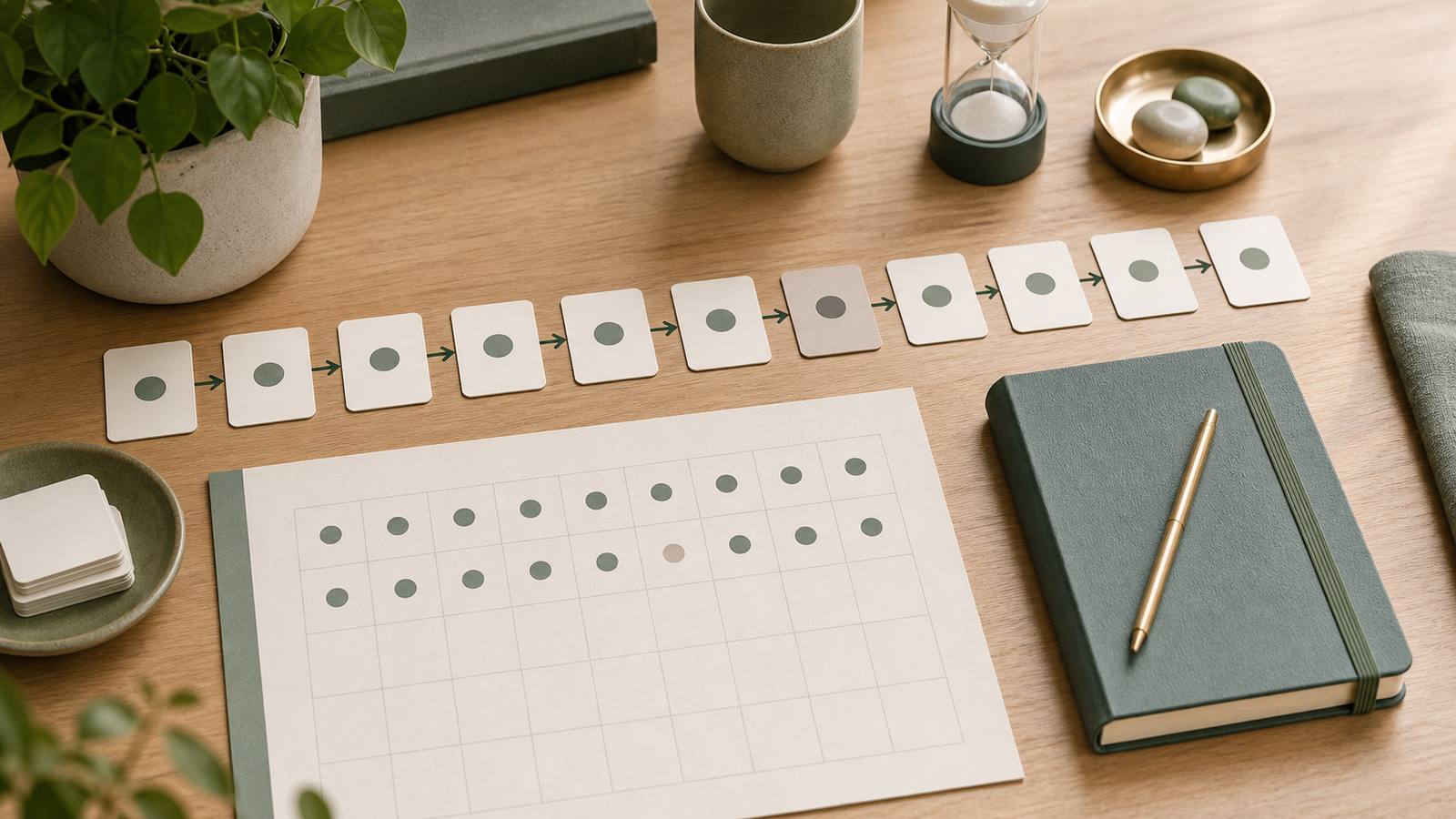

You ask a friend to check in on you every Monday. It works for three weeks. Then Monday becomes a text you both forget to send, and neither of you brings it up again.
This is not a discipline problem. It’s a design problem. An accountability partner asks another person to hold the truth about your progress. The moment they get busy, forget, or stop asking, the truth stops surfacing. You’re back where you started, except now you also feel like you let someone down.
It makes sense that people reach for a partner first. Wanting support isn’t the mistake. Putting the job of surfacing truth onto a relationship instead of a structure is.
An accountability system works differently. It doesn’t need a person to notice you slipped. It makes the slip visible to you, first, before anyone else would need to say anything.
I learned this the slow way, running a youth entrepreneurship program across Morocco’s South Region, with a target of 400 young people to reach that year. Nobody had to ask me every week how the numbers were doing. The dashboard already showed it. If enrollment was behind pace for the month, I saw it the moment I opened the sheet, not when a supervisor eventually asked. The dashboard didn’t judge me. It just told the truth, on a fixed schedule, whether I wanted to look or not.
That’s the actual definition of an accountability system: a structure that surfaces the truth on its own schedule, independent of anyone’s memory, including yours. It’s the same idea behind building an honest dashboard for your own life, applied specifically to the moment someone else’s attention used to be doing the work.
Key Takeaways
- An accountability partner asks another person to hold the truth about your progress, and the moment they get busy or forget, the truth stops surfacing.
- An accountability system doesn’t need a person to notice you slipped, it makes the slip visible to you first.
- Three things make something a system: a visible number, a fixed review point, and a decided-in-advance rule for what happens when the number drops.
- Miss any one of the three and you’re back to hoping you’ll remember, or hoping someone else will ask.
- Start smaller than the dashboard you’re imagining, a single number on a shared sheet, checked on a fixed day, is enough to begin.
Why a person can’t do this job
A person forgets. A person gets tired of asking. A person eventually stops wanting to be the one who nags. None of that is a character flaw in your accountability partner. It’s just what happens when you place the job of surfacing truth on a relationship instead of a structure.
A system doesn’t get tired. It doesn’t take it personally when the number is bad. It just shows the number.
What actually makes something a system
Three things, and you need all three or it collapses back into willpower.
A visible number. Not a feeling, not “I think I did okay this week.” A specific, countable thing: pages written, workouts logged, calls made, whatever the real unit of progress is for what you’re building.
A fixed review point. Same day, same time, every week, regardless of how the week went. The review happening on a bad week is what makes it a system instead of a mood.
A rule for what happens when the number drops. Not a punishment, a next action that’s already decided in advance, so you’re not negotiating with yourself in the exact moment you’re most likely to talk yourself out of it.
Miss any one of these three and you’re back to hoping you’ll remember, or hoping someone else will ask. This is also why a system that keeps breaking is usually missing one of the three, not all of them.
Start smaller than the dashboard you’re imagining
You don’t need software for this. I didn’t build anything elaborate for the South Region program at first. It started as a single number on a shared sheet, checked every Friday, whether the week had gone well or badly. The complexity came later, once the habit of looking was already there.
It shouldn’t feel exciting, either. The systems that actually hold are the ones built to be boring, not the ones dressed up to keep you motivated.
This is one small piece of a larger idea I keep coming back to. A life or a body of work doesn’t stay on track because you have more willpower than the next person. It stays on track because something in how it’s built keeps telling you the truth before you’d have to ask. In the Method, that’s a System problem, in the fullest sense, the infrastructure underneath the four pillars, Continuity included, that either holds them together or lets them quietly drift.
Build the number first. The system follows. The partner was never the point.
Frequently asked questions
What is an accountability system?
A structure that surfaces whether you’re on track on a fixed schedule, without depending on another person’s memory or attention. It needs three parts: a visible number, a fixed review point, and a decided-in-advance rule for what happens when the number drops.
Does having an accountability partner even work?
Sometimes, for a while. It tends to fail quietly once the other person gets busy, because the job of noticing your progress was placed on their memory instead of on a structure. A partner can support a system. A partner is not a substitute for one.
What’s the very first number to track if I’ve never done this before?
Whatever single action, if repeated, would actually move the thing you care about: pages written, calls made, workouts logged, minutes practiced. Pick the one number closest to the real work, not a proxy for it, and write it down somewhere you’ll actually see it on the same day each week.