
I spent five years in corporate roles, moving from consulting into project management into IT service management, before working on a major business transition between two companies. One lesson stuck harder than any other during those years: nobody was ever allowed to just say “the system is broken.” That sentence was treated as lazy. You were expected to name the exact dependency that failed, the specific handoff, the specific interface, the specific link between two teams.
I still use that habit constantly, and it has a name: systems thinking.
Key Takeaways
- Systems thinking means finding exactly where a connection failed, instead of blaming the whole.
- System, in the Method, is not the same as systems thinking: System is the specific infrastructure connecting the four pillars to your identity, entities, and energy.
- Name the parts of what feels broken before deciding the whole thing isn’t working.
- Follow where things are waiting, not where they’re loud; the real constraint rarely announces itself.
- Check one connection at a time rather than rebuilding everything at once.
What is systems thinking, exactly?
Systems thinking is the ability to see how the parts of something affect each other, and to find exactly where a connection has failed, instead of blaming the whole.
It isn’t an abstract theory for engineers and consultants. It’s a habit anyone can train. When something goes wrong, systems thinking looks for the broken link before it looks for someone to blame. It asks a specific question: what touches what here, and which connection actually gave way?
The confusion most people make: systems thinking is not the same as System
In the Method, the four pillars, Intention, Continuity, Mastery, Impact, are sustained by a fifth element at the center: System. System is the infrastructure that connects those four pillars to your identity, your entities (yourself, your family, your organization, your community), and your energy.
Systems thinking is not that System. It’s the lens you can point at any group of connected parts: a marriage, a team, a supply chain, a single work week, without any of them being “a System” in the Method’s sense.
Mixing up the two leads to a specific mistake. People conclude they need to rebuild everything, when they actually just need to trace one broken link.
Where this way of seeing comes from, for me
I studied information systems engineering at École Mohammadia d’Ingénieurs. That training, and the corporate years that followed, taught me to look for the specific broken link before accepting any verdict on the whole. That habit turned out to be just as useful later, once I started working with people and organizations on questions of intention, continuity, and impact, far from any technology project.
How to practice systems thinking day to day
Three moves are enough to start, and none of them require an engineering degree.
Name the parts, not the whole. Before deciding that a relationship, a team, or a week “isn’t working,” list the actual components: who does what, when, depending on whom. The whole is almost never the problem. One of its parts is.
Follow where things are waiting, not where they’re loud. The loudest symptom is almost never where the actual break happened. This is the same logic behind The Bottleneck Always Moves: the real constraint sits wherever things are waiting, not wherever they’re making noise.
Check one connection at a time. Resist the urge to overhaul everything at once. Isolate a single link, test it, then move to the next one. It’s slower than a full rebuild, and it’s almost always the approach that actually works.
A real example
Take a common situation: a morning routine that “just doesn’t work anymore.” Look closer and it’s rarely the whole morning that’s the issue. It’s usually one link, the gap between wake-up time and departure time, shifted by twenty minutes after a schedule change at work. Once that link is named, the fix takes five minutes. Without systems thinking, the same problem gets treated as a reason to rebuild an entire morning routine, when it lived in one connection all along.
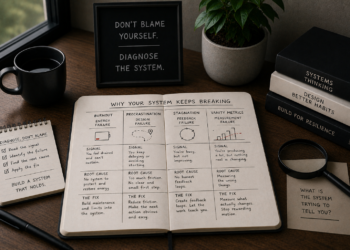
This is the same principle behind how I diagnose a personal system that keeps failing in the same place, covered in How to Diagnose Why Your System Keeps Breaking.
Frequently asked questions
What’s the difference between systems thinking and System, in the Method?
Systems thinking is a way of seeing the links between the parts of something. System, in the Method (Intention, Continuity, Mastery, Impact, sustained by System), is the specific infrastructure that connects those four pillars to your identity, your entities, and your energy. You can think systemically about many things that are not “a System” in the Method’s sense.
Do you need an engineering background to think systemically?
No. Engineering training helps you notice it earlier, but the habit is built through practice: naming the parts before judging the whole, following where things wait rather than where they’re loud, and checking one connection at a time instead of rebuilding everything.
The next time a project, a relationship, or a week feels like it’s falling apart, resist the urge to rebuild all of it. Look first for the link that gave way. It’s almost always simpler, and truer, than you expected.
Can systems thinking make you over-analyze simple problems?
It can, if every hiccup gets treated as worth a full investigation. The habit is meant for situations where something recurring or costly keeps breaking, not every minor annoyance. If a five-minute fix is obvious, take it; save the parts-not-whole method for problems that survive a first quick fix and come back.