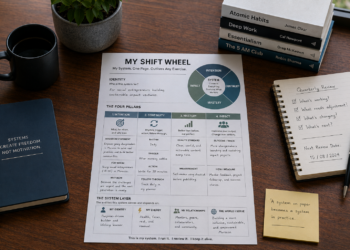

Reading a completed system back tells you something a to-do list never will: not just what you’re doing, but whether the pieces are reinforcing each other or quietly working against each other. The Weakest-Pillar Review is that read-back.
Most imbalance stays invisible
Most imbalance stays invisible because the four pillars usually get judged separately, one goal at a time, one habit at a time. Seeing them together changes what you notice.
This is also, honestly, one of the more useful few minutes in this entire library, not because it teaches something new, but because it shows you what you already have, all at once.
Who this is for, and how long it takes
About 7 minutes. Works best after The Four-Pillar Recall and The System Layer Worksheet.
What’s inside
- A recap table.
- A weakest-pillar prompt.
- A one-adjustment field.
How to get the most out of it
Make one small adjustment, nothing dramatic. This isn’t the moment to rebuild anything.
What changes if you actually do this
The output is one adjustment to the weakest pillar. The outcome is that you stop treating each pillar as a separate project. The impact is that the whole system holds better under pressure.
Download The Weakest-Pillar Review
Next step: The Foundation Phase Planner, for turning this into something that survives a normal month.
FAQ
How is this different from the full Personal OS Blueprint?
The full blueprint builds all three steps, recall, connect, review, in one roughly 30-minute sitting. This is the final third, the read-back and adjustment.
What if I can’t tell which pillar is weakest?
Look for the one you’re most tempted to skip talking about. That’s usually the honest answer.
How often should I redo this?
Whenever something feels off, or at least once a quarter as a check-in.