
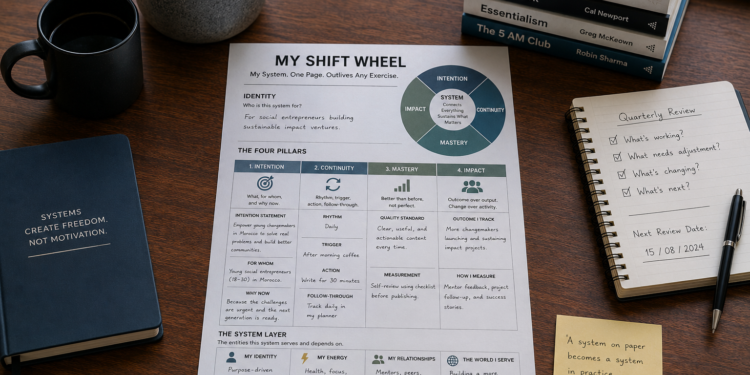
When you started, there was a gap between intention and action. My Shift Wheel isn’t a summary of what you learned along the way. It’s the actual system you built, compressed onto one page, meant to outlast the sequence that produced it.
A course ends. A system shouldn’t.
Most programs end with a notebook full of insight and no single page anyone actually returns to. The insight fades within weeks. A working reference document doesn’t, if it exists.
What the document holds
Identity: who this system is actually for. Then the four pillars, in one place.
- Intention: your intention statement, what, for whom, why now.
- Continuity: your rhythm, trigger, action, follow-through.
- Mastery: your current quality standard, better than before, not perfect.
- Impact: the outcome you’re actually tracking, not just the output.
Then the System layer: the entities this system serves, your identity, your energy, the people around it. My Shift Wheel is where all five elements of the Method, Intention, Continuity, Mastery, Impact, sustained by System, live on one page. Everything built across the earlier Shift Wheel exercises compresses into this.
Who this is for, and how long it takes
For anyone who has completed the earlier Shift Wheel exercises. Revisit it quarterly, not just once.
What’s inside
- An identity section.
- A four-pillar table.
- The System layer connecting them.
How to get the most out of it
Keep it somewhere you’ll actually see it, not archived in a folder you never open. Update it when a pillar changes rather than starting a new document from scratch.
What changes if you actually do this
The output is one completed one-page document. The outcome is a reference independent of the course that produced it. The impact is that the Shift Wheel becomes a system you keep running, not a program you finished.
Download the document
Next step: Read the Method →, or see the 90-Day Implementation Plan, the plan this document compresses.
FAQ
Do I need to finish all the earlier exercises first?
Yes, this document compresses what they produced. Filling it out without them means guessing at your own system.
How often should I update it?
Whenever a pillar changes meaningfully, and at minimum once a quarter as a check-in.
What if my system has clearly changed since I built it?
That’s expected. Update the document rather than treating the original version as fixed.