There is a particular kind of decision that never gets made and never goes away. It shows up, you push it to later, and it comes back. Then you push it again. It is not urgent enough to force your hand and not small enough to disappear, so it sits there, returning week after week, quietly taking a little energy each time.
I call it the snooze-button decision, after the alarm you silence five times instead of just getting up. Each snooze feels like relief. Together they cost more than the thing you were avoiding.
Why deferring is expensive
A decision you keep postponing does not wait politely in the background. It stays slightly active, an open loop your mind keeps reopening to confirm it is still unresolved. Ten of these running at once is a real tax on your attention, and most people are paying it without noticing.
The cost is rarely in any single decision. It is in the accumulation. A system clogged with deferred choices feels heavy for reasons you cannot quite name, because the weight is spread across a dozen things you are not currently looking at.
The test
Here is the test. Any decision you have deferred more than twice is no longer a decision you are making. It is a decision the system is making for you, by default, in the worst possible way: through avoidance.
The second deferral is the signal. Once is normal; you genuinely did not have time. Twice is a pattern. By the third return, the postponing itself has become the decision, and it is almost always the wrong one.
What to do with them
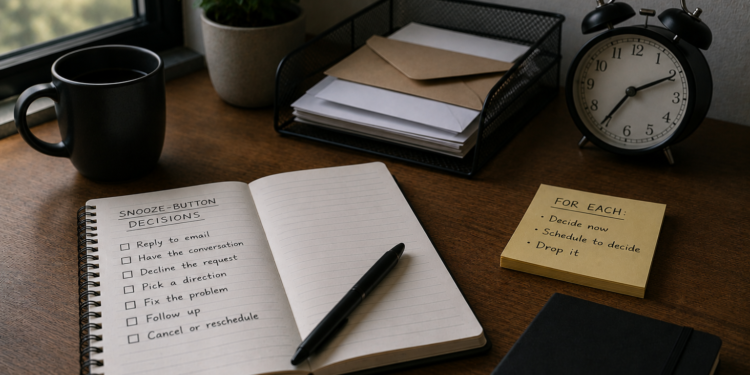
Gather the snooze-button decisions in one place. They are easy to spot once you look: the email you keep not answering, the conversation you keep not having, the small commitment you keep not declining.
Then force a resolution, even an imperfect one. For each, do one of three things: decide it now, schedule a specific time to decide it, or consciously drop it. The third is a real option. Some decisions deserve to be closed by deciding they do not matter.
What you cannot afford is to leave them open, drawing energy on a loop. A system works partly by closing things. The decisions you keep snoozing are the ones quietly keeping it from running clean.