
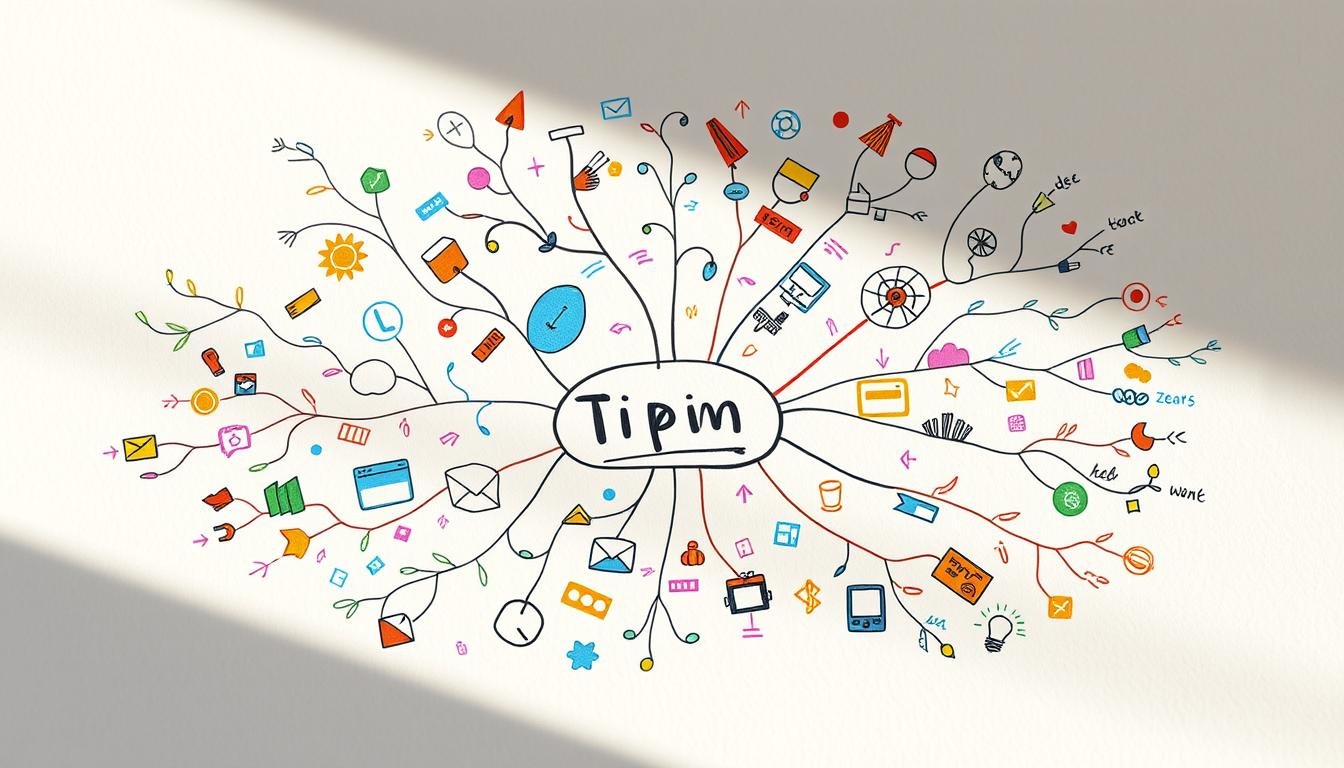
A mind map is a way of organizing ideas visually around a central idea, instead of listing them in a linear list. Its real value isn’t the drawing itself, it’s what it forces you to clarify: how those ideas actually connect to each other.
Key Takeaways
- A mind map organizes ideas around a center, not in a linear list.
- Linear reading is rarely enough to understand ideas that are heavily interconnected.
- The real value isn’t how nice the drawing looks, it’s being forced to define the relationships between ideas.
- A complex topic that feels scattered in your head often clarifies once you start from one central idea.
- The exercise reveals connections that written text doesn’t always show.
Why This Is Harder Than It Looks
During my engineering studies, some subjects contained enormous amounts of interconnected information, and linear reading wasn’t enough to understand the relationship between ideas. Drawing a simple mind map, the main idea in the center and the sub-ideas around it, revealed connections I hadn’t seen in the written text.
The real value isn’t how nice the drawing looks, it’s being forced to define how ideas relate to each other, not just list them. That connects to Continuity, one of the five elements of The Method, since organizing your thinking is itself a form of lasting structure.
The Steps
Step 1: Place a single central idea in the middle of the page. Starting with several central ideas dilutes the exercise from the start.
Step 2: Add sub-ideas as branches around the center. Each branch should answer the question of how it connects to the central idea.
Step 3: Connect branches to each other when a real link exists. This step, not the drawing, is what reveals the topic’s real structure.
Step 4: Review the map and ask whether each drawn connection is real or just convenient. A connection drawn for convenience rather than accuracy produces false clarity.
A Worked Example
Faced with a topic that felt scattered in my head, starting from a single central idea and tracing what actually emerged from it made a structure visible that hours of linear reading hadn’t shown.
Closing
Next time a complex topic feels scattered in your head, don’t write a new list. Start from one idea at the center, and see what actually emerges from it.
FAQ
Do I need special software to make a mind map?
No. Paper and a pen are usually enough; the mental exercise matters more than the tool used.
What if no clear connection appears between certain branches?
Leave them separate. Forcing a connection that doesn’t exist produces false structure, which defeats the exercise.
Does this work for organizing a project, not just learning?
Yes, the same principle applies: one central idea or goal, and the elements that genuinely emerge from it.