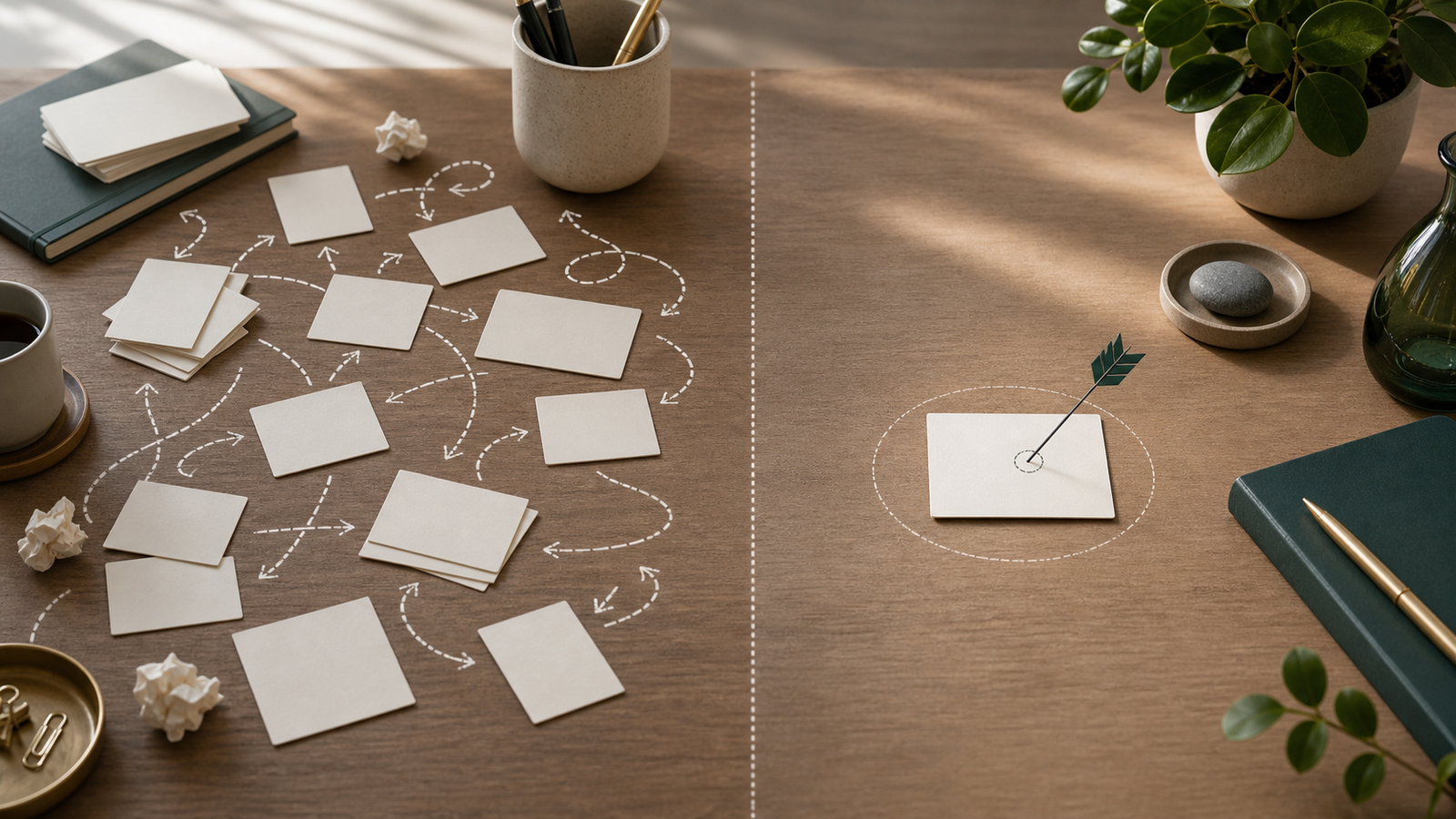
Being busy measures motion. Having an impact measures change. It is possible to be extremely busy and change nothing at all.
This confusion is costly because it disguises itself as virtue. Someone with a packed schedule looks serious, committed, useful. But a full calendar proves nothing about what actually changes because of them.
Activity feels like progress. Checking off tasks gives an immediate sense of forward motion. But moving is not the same as arriving: you can run all day and stay exactly where you started.
Busyness is comfortable because it is easy to measure and easy to display. Asking yourself what you are actually changing is more uncomfortable, since the honest answer can be disappointing. Staying busy is sometimes a way of avoiding that question.
Being busy, having influence, and having impact are three things people often confuse. Being busy means doing a lot. Having influence means being seen, heard, followed. Having impact means producing a real change in someone else’s situation. You can be busy without influence, influential without impact, and, more rarely, have a quiet impact without much visibility at all. Confusing the three means risking that you chase motion or visibility while believing you are chasing impact.
Leading field program implementation, then later working on impact measurement at the Miller Center for Social Entrepreneurship, I saw the same pattern from both sides. Intense activity guarantees no result on its own. Programs could multiply events, workshops, and reports while barely changing the real situation of the people they targeted. A modest, well-aimed action, on the other hand, could produce a clear shift. Volume does not decide impact. Precision does.
Here is a simple test. Take one of your recurring activities and ask: if I stopped doing this tomorrow, what would actually change, and for whom? If the honest answer is nothing visible, that activity is feeding your busyness, not your impact. Applied honestly to a full week, this test quickly reveals what matters and what is only filling time.
Moving from busy to impactful starts with naming the change each activity is meant to produce. An activity with no intended change is an activity worth questioning. Cutting what changes nothing frees up time and energy for what actually matters, since doing less that counts beats doing more that doesn’t. And it means tracking the right thing: not how many things got done, but what changed as a result. What you measure shapes what you do, so measure impact and you will start working for impact.
Moving from busyness toward impact sits at the center of the fourth pillar. The first concrete step is usually learning to measure what actually changes.
Is being productive the same as having an impact?
Not necessarily. Productivity measures how much work gets done, while impact measures the change produced. You can be very productive on tasks that change nothing important.
How do I know if I am only busy?
Apply the stop test to your recurring activities. Anything whose absence would change nothing visible belongs to busyness, not impact.
Isn’t influence a form of impact?
Influence can lead to impact, but it is not impact itself. Being seen and heard does not prove that a real change has happened. Influence is a possible means; impact remains the result worth measuring.